|
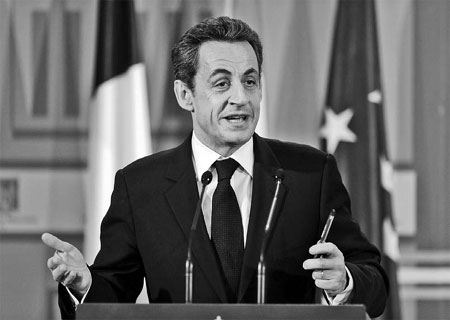
French President Nicolas Sarkozy is trying to make good on a pledge he made last year to impose a tax on financial transactions, despite heavy opposition from the financial community and questions of feasibility by the Bank of France. Denis Doyle / Bloomberg
Sarkozy hopes measure will shrink nation's budget deficit, spur growth
France plans to unilaterally impose a 0.1 percent tax on financial transactions starting in August, President Nicolas Sarkozy said, brushing aside opposition from the nation's banks.
"What we want to do is provoke a shock, to set an example," Sarkozy said on Sunday in Paris. "There's no reason why deregulated finance, which brought us to the current situation, can't participate in the restoration of our accounts."
The country's financial community opposes the levy and its feasibility has been questioned by the Bank of France. It has become a political challenge for the president, who faces elections in a two-round vote in April and May and wants to make good on a pledge he made to impose such a tax when France last year held the presidency of both the G8 and G20 groups of countries.
The European Commission in September suggested a tax of 0.1 percent on equity and bond transactions and 0.01 percent on derivatives, which it said could raise 55 billion euros ($71 billion) a year. European Union finance ministers are due to discuss the levy in March.
The financial transactions tax is among measures Sarkozy unveiled to shrink the French budget deficit and spur growth. He's also increasing sales taxes and levies on financial incomes to fund a 13-billion-euro cut in payroll charges aimed at reducing labor costs and making France more competitive.
Bank shares
The French government, long a proponent of the transaction tax, stepped up its campaign this month, saying it would impose the levy even if others didn't. Sarkozy said he expects revenue of 1 billion euros from the tax "that will go toward cutting the deficit".
Shares of France's three biggest banks tumbled. BNP Paribas SA slid as much as 4.1 percent, trading 3.4 percent lower as of 9:08 am in Paris at 33.45 euros. Societe Generale SA fell as much as 4.3 percent to 20.17 euros, while Credit Agricole SA declined as much as 2.7 percent to 4.8 euros.
Jean-Pierre Jouyet, president of the Autorite des Marches Financiers, France's financial regulator, said last week that the tax on transactions advocated by Sarkozy would weaken the country's position in the asset-management industry by pushing professionals and transactions elsewhere.
Sarkozy said on Sunday that his government has found a way to keep financial jobs in France and tax transactions related to the country even if they happen elsewhere, pointing to credit default swap (CDS) trades as an example. He didn't give details.
Negative effect
"CDS's, which are speculative instruments against sovereign debt, will be taxed and online speculative purchases will be taxed," he said.
The tax will apply to share purchases, including high frequency trading, and CDS transactions. Unlike the European Commission proposal, it will not apply to bond trading.
Ernst & Young LLP, an accounting company, has said in a report that while an EU transaction tax itself may raise as much as 37 billion euros, its net effect could be negative by between 2 billion euros and 116 billion euros from decreasing economic activity and reducing revenue from other taxes.
The United States opposes taxes on transactions, preferring bank levies based on the size of their balance sheets.
The United Kingdom, home to Europe's biggest financial center, has also opposed the tax as it is currently proposed. Prime Minister David Cameron said on Jan 26 that a Europe-wide transaction tax would be "madness", saying it would cost 500,000 jobs.
Germany is considering a plan for a form of European stamp duty on shares linked to tougher trading rules as an alternative to a financial-transaction tax, in an effort to win over the UK to adopt an EU levy.
Investors buying UK shares pay a tax of 0.5 percent on the price. The stamp duty is also levied on options to buy shares and rights arising from shares. It is not levied on foreign shares. Stamp duty on shares raised 3 billion pounds ($4.7 billion) in the year to April 2010, according to the government.
German Chancellor Angela Merkel's Christian Democrats and their Free Democratic Party allies may be coalescing around an FDP proposal for a Europe-wide tax along the lines of the UK's levy on shares.
Such a solution is a "good option" if accompanied by rules that limit "abusive excesses" in automated trading, the Free Democrats have said in a paper drafted by former Economy Minister Rainer Bruederle.
The French financial industry has spoken out against imposing a transaction tax unilaterally in France.
"A tax that's limited to France would weigh on growth, lead to a loss of competitiveness, and create a heavy handicap for the financing of the French economy," the French Banking Federation said in a statement on Jan 9. |