

By Wang Kai
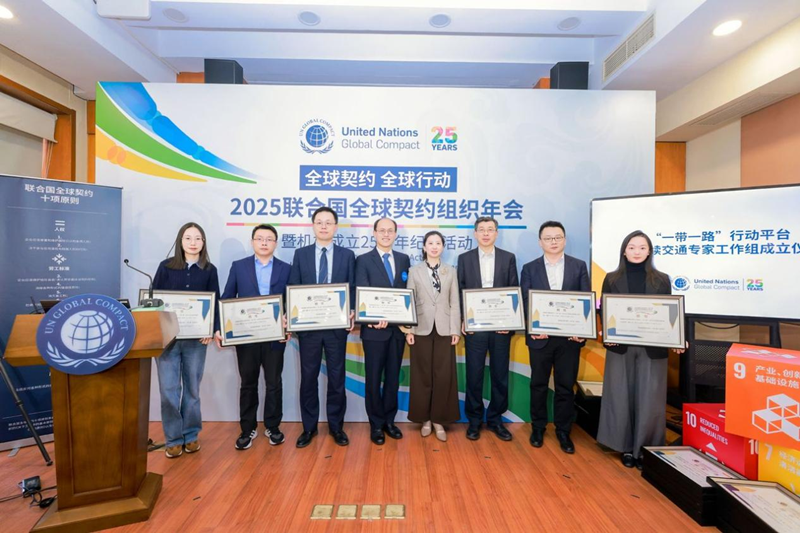
At the 25th anniversary of the founding of the UN Global Compact (UNGC) held in Beijing on December 2nd, 2025, batches of Chinese companies and research institutions joined the Belt and Road Action Platform expert groups in transportation, finance, compliance, medicine, and sustainable social value ecosystem. [Photo provided by UNGC)
In Pakistan, China-donated solar lights are set to illuminate the streets of power-short Karachi, offering residents safer and more reliable night-time visibility. In Kazakhstan, a drought and pest monitoring and early-warning system jointly developed with China has created an integrated air–space–ground network now regarded as one of the most advanced disaster-prevention tools in Central Asia.
China's efforts to shift toward sustainable development is still pacing up, drawing renewed attention from international investors, even as the global green-finance market shows signs of slowing.
Latest data from the London Stock Exchange Group show that by late October, global green-bond issuance dropped 11 percent from a year earlier. China moved in the opposite direction, increasing green-bond issuance by 92 percent to USD 101.8 billion, representing about 20 percent of the global total. Financial institutions, according to Wind, a provider of financial data and analysis tool services in China, issued more than 240 green bonds this year, with a combined value exceeding RMB 640 billion—roughly double the volume recorded in 2024.
Sustainable inputs are driving some of the world's most pioneering products — from the first carbon-neutral intelligent lawn-mowing robot to cleaner cement-production methods that turn solid waste into usable resources and achieve carbon-neutrality through Carbon Capture, Utilization and Storage (CCUS).
"The shift toward integrating sustainability considerations into governance, strategy and operational processes marks a significant change in how major firms organize and report their activities," said Song Zhiping, president of the China Association for Public Companies at an event in Beijing this week marking the 25th anniversary of the founding of the UN Global Compact.
The Association reports that 2,481 A-share firms have released sustainability reports for 2024, bringing the disclosure rate to 46 percent. These companies account for roughly 70 percent of the total value of the total market value of all A-share listings — meaning ESG reporting has effectively become standard practice among major publicly traded firms.
"Among the reporting companies, 67.3 percent have set up dedicated governance structures for sustainability work, 63.9 percent disclose strategic information, and 44 percent have established quantitative sustainability targets," Song noted.
Corporate results show the degree of resilience. In the first three quarters, 17 of 19 major industry categories recorded profits, with advanced manufacturing highlighted as an area of growth. Across the market, research and development spending has exceeded RMB 1 trillion for three consecutive years, Song shared.
ESG ratings for Chinese companies have also improved. By the end of 2024, roughly one-third of firms listed in Shanghai and Shenzhen had seen upgrades from rating agencies, and the proportion of companies in the higher rating bands (AAA and AA globally) increased to 7.2 percent, a notable change from five years earlier when the figure was essentially zero.
"Companies are becoming more active in communicating sustainability-related strategies during earnings briefings, roadshows and investor outreach. This increased transparency is becoming a more important factor for global investors evaluating long-term value," Song said.
According to the 2024 China Patent Survey Report, nearly half of Chinese enterprises have already undertaken or plan to undertake green-technology innovation. Over the past decade, China has helped drive down the global levelized cost of wind and solar power by more than 60 percent and 80 percent, respectively. Traditional industries are also seeing major breakthroughs: million-ton hydrogen-metallurgy production lines and 300,000-ton green ammonia facilities have now completed full-process integration, and million-ton carbon capture, utilization and storage (CCUS) projects have been brought online.
Transport sector stands out in driving sustainable practices globally. Xie Hui, deputy director of the Global Sustainable Transport Innovation and Knowledge Center under China's Ministry of Transport, revealed at the UN Global Compact 25th Anniversary event that in the Global Sustainable Transport Implementation Plan to be released by the UN on December 10 for the UN Decade of Sustainable Transport 2026 - 2035, all of the seven proposals of China have been adopted.
"These include frameworks for sustainable transport systems, case-study collections, partnerships on zero-carbon freight and electric mobility, etc.," according to Xie. "Future areas of focus include improving international interoperability of transport-related technical standards, building shared knowledge resources, and supporting demonstration projects."
"China aims to adapt its domestic experience in transport development into global public goods," Xie said.
(Editor: liaoyifan )