


by Meng Fanrong
WUHAN, Dec. 25 (China Economic Net) - Pakistan is significantly enhancing its agricultural modernization efforts by deploying 1,000 specialists to China for specialized training, a key initiative under the diplomatic commitment of both nations' leaders. The multi-phase program, designed to cultivate expertise in advanced agricultural technologies, biotechnology and sustainable practices, has already seen around 700 professionals return to Pakistan with enhanced skills, while new groups continue to arrive for ongoing and upcoming training sessions.
A key component of this initiative is the current training on seed production and processing technology. Jointly organized by Huazhong Agricultural University — a leading Chinese university in agricultural sciences — and Wuhan Qingfa-Hesheng Seed Co., Ltd., which has over two decades of collaboration experience with Pakistan, the program runs from November 10 through next February.
It adopts an integrated "theory plus practice" approach designed to enhance the professional competencies of 56 Pakistani participants. All the trainees hold at least a master's degree and represent diverse sectors including government, businesses, academia and civil society organizations from across Pakistan. Notably, 11 female participants are contributing to the growing role of women in agricultural innovation.
The curriculum encompasses critical areas such as crop breeding science, seed production systems, variety selection and processing technologies. Through visits to production facilities, research laboratories and corporate farms, participants gain hands-on exposure to modern agricultural operations.

Mr. Muhammad Anser visits the 2025 Hubei Agriculture Expo during his training program in China. Photo provided to CEN
Mr. Muhammad Anser, a seed industry representative from Gujranwala, Punjab, shared his experience midway through the program: "This training has provided us with remarkable exposure to China's technological advancements. The integration of molecular-assisted breeding, gene editing and inustrial research demonstrates how innovation translates into tangible farming solutions."
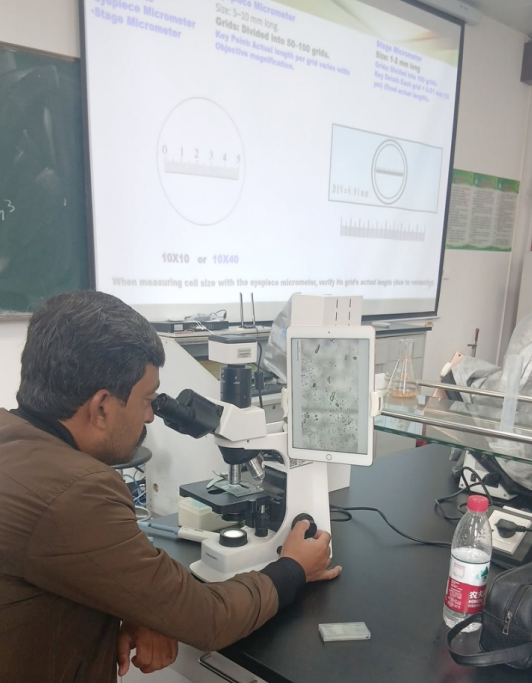
Mr. Maqbool Ahmed in a lab during his training program in China, photo provided to CEN
Mr. Maqbool Ahmed, an agricultural extension officer from Quetta, Balochistan, emphasized the program’s significance, “This initiative offers precisely the knowledge and skills Pakistan needs to enhance agricultural productivity. China’s excellence in seed technology and modern breeding methods provides invaluable lessons for our development, particularly through its practical, problem-solving approach that incorporates AI and sustainable practices.”
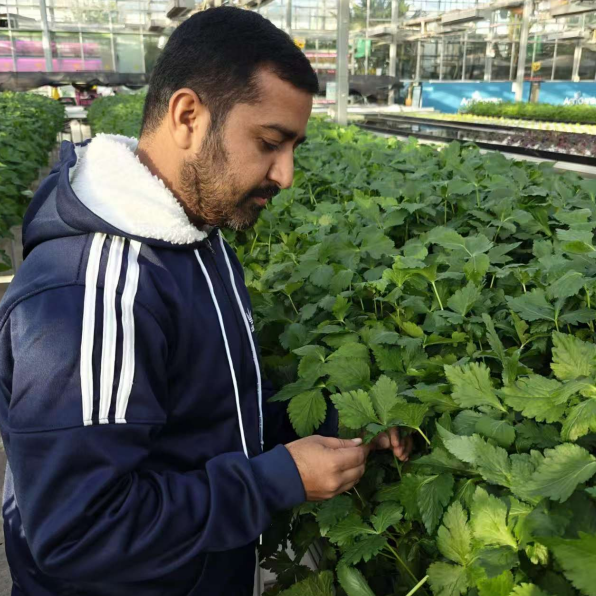
Mr. Rashdi Syed Muzafar Ali Shah in a field visit during his training program in China
Mr. Rashdi Syed Muzafar Ali Shah, an organic cotton project coordinator from Lasbela, Balochistan, highlighted the program’s focus on agricultural fundamentals, “Seeds form the foundation of farming productivity. The techniques we’re learning in seed production, certification, and protection will directly contribute to improving seed quality and farmer livelihoods in our region.”
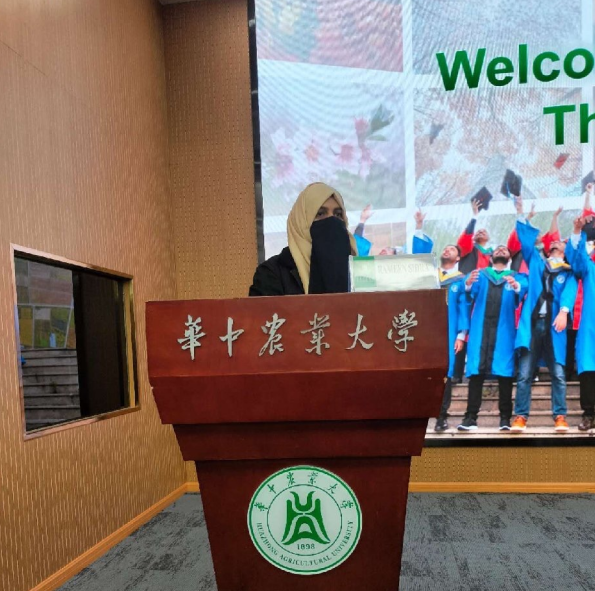
Ms. Sidra Rameen at Huazhong Agricultural University during her training program in China, photo provided to CEN
Ms. Sidra Rameen, an environmental program officer with Ghazi Barotha Taraqiati Idara, articulated the broader impact, “We see ourselves as bridges between China and Pakistan – transforming acquired knowledge into practical solutions for sustainability and innovation. Through such cooperation, we contribute not only to Pakistan's food security but also to strengthened bilateral relations and shared agricultural progress.”
This ongoing initiative represents a substantial step in Pakistan-China agricultural cooperation, combining theoretical knowledge with practical applications to address contemporary farming challenges. By focusing on advanced technologies and sustainable methods, the program is creating a skilled workforce capable of driving agricultural transformation across Pakistan, with particular benefits for regions such as Balochistan where modern farming techniques can substantially improve rural livelihoods and economic resilience.
(Editor: liaoyifan )