

by Wang Kai
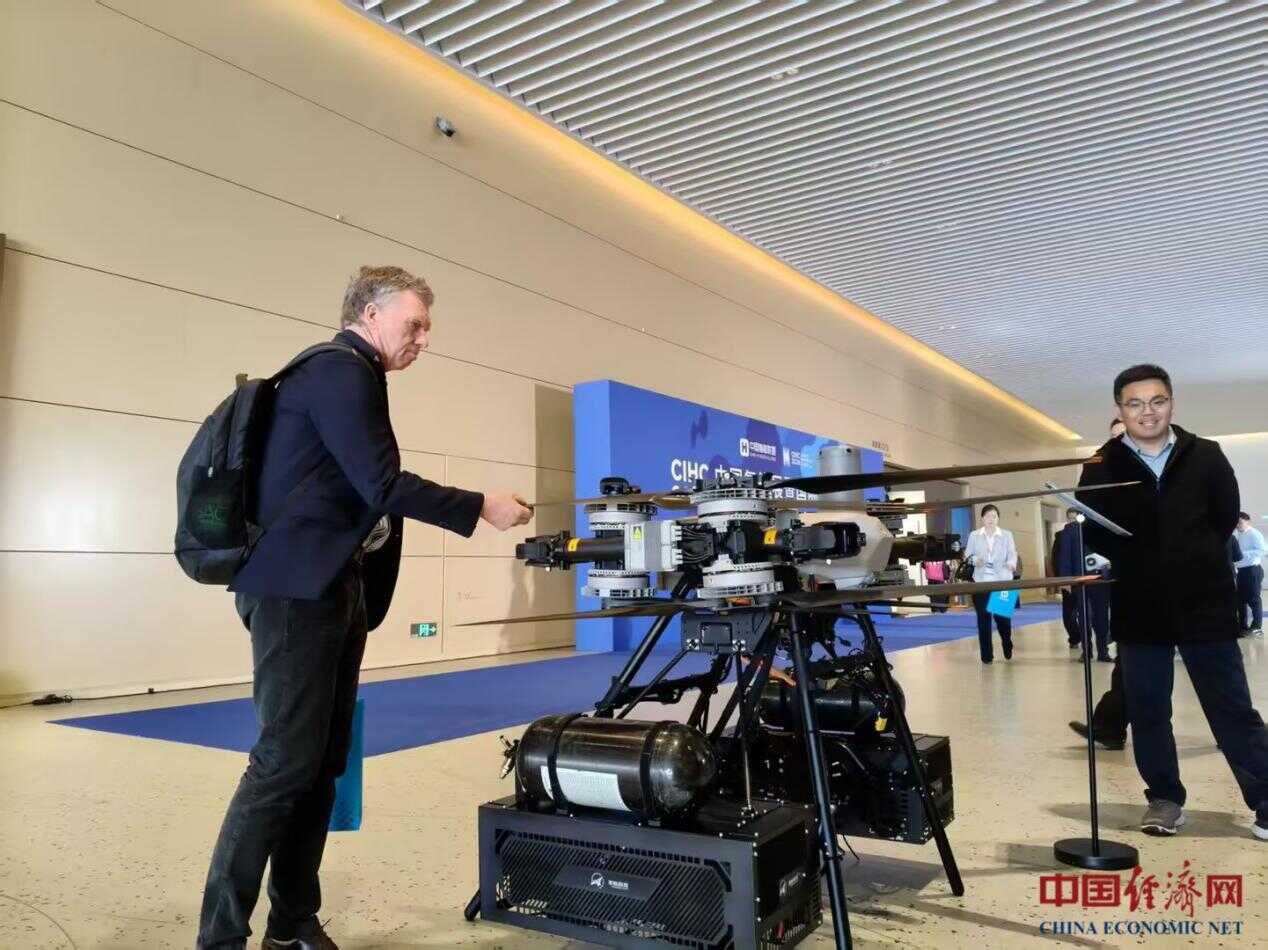
Hydrogen-powered UAV on display at the 16th Clean Energy Expo China (CEEC) held in Beijing on Mar. 25-27, 2026. [Photo/Wang Kai]
"China leads the game in renewable hydrogen production capacity. Of the $110 billion committed investment globally in clean hydrogen, China accounts for nearly a third ($33 billion). We can open new trusted energy partnerships to keep driving our industries forward to ensure that we maintain industrial competitiveness, which means high quality jobs and booms for both the economy and the society," Ivana Jemelkova, CEO of the Belgium-headquartered Hydrogen Council said at the Clean Energy Expo China (CEEC) held in Beijing last week.
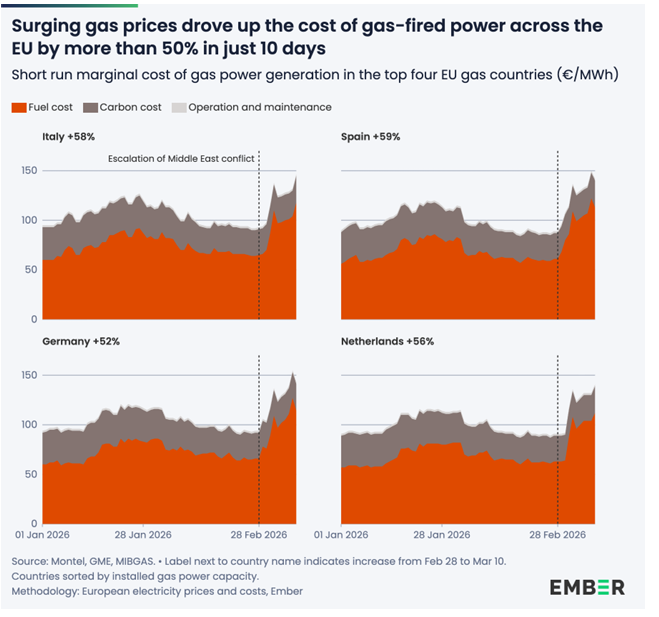
As a net energy importer, Europe is grappling with soaring prices—gas futures have doubled and oil prices have risen by more than 50% since the start of the year. According to global energy think tank Ember, wind and solar accounted for 30.1% of EU electricity generation in 2025—well short of the 60%-plus target for 2030. Meanwhile, energy security remains fragile: in the first ten days of the latest Middle East conflict, the cost of gas-fired power in Europe jumped by more than 50%. Shell's executive Wael Sawan warns energy shortage as early as next month.
Green hydrogen produced through electrolysis of water is regarded by the EU as one of the core strategies to address climate change and reduce reliance on fossil fuels. In its REPowerEU strategy, the EU set a target of 10 million tons for both domestically produced and imported renewable hydrogen by 2030.
A representative from TÜV SÜD, a German-based testing, certification and inspection group, underscores that Europe faces an acute need for hydrogen to address three interconnected crises: energy security, industrial decarbonization, and climate compliance.
This trend aligns with the broader global momentum. According to the Hydrogen Council, committed investment in the clean hydrogen sector has grown at an average annual rate of over 50% since 2020. The investment attracted by clean energy is now nearly twice that of fossil energy, data from the International Energy Agency shows.Yet green hydrogen still accounted for less than 1% of global output in 2025, underscoring the vast potential for future growth.
Vineet Bhatia, a senior adviser at the United Nations Development Programme in China, notes that China, already boasting the world's largest fleet of fuel-cell vehicles and the most extensive network of hydrogen refuelling stations, is well placed to scale solutions, backed by its ambitious Hydrogen Energy Development Plan (2021–2035).
Hydrogen has been earmarked as one of six "industries of the future" in the country's five-year plan for 2026-2030. By the end of 2025, China's annual hydrogen production and consumption exceeded 37m tonnes, with renewable-powered electrolysis capacity more than doubling to over 200,000 tonnes per year. Nearly 40,000 fuel-cell vehicles are now on the road, supported by 574 refuelling stations—the most in the world.
Costs, crucially, are falling. A report by China's National Energy Agency suggests that the cost of electrolytic hydrogen production has dropped by nearly 40% since 2020. In Inner Mongolia, a northern China's province known for vast grasslands, green hydrogen output surpassed 12,000 tonnes in 2025, with production costs hovering at 17–20 yuan ($2.30–2.70) per kilogram—approaching parity with coal-based hydrogen.
Green hydrogen: towards large-scale application
China's annual production and consumption of hydrogen energy have exceeded 36.5 million tons, accounting for 36.6% of the global total, ranking first globally for multiple consecutive years.
Leveraging abundant wind and solar resources, the country is rolling out "wind–solar–hydrogen–storage" projects at pace. By August 2025, more than 800 such projects were planned, under construction or operational, with combined investment exceeding 600bn yuan.
This month, the country's first 10,000-tonne photovoltaic hydrogen project, in Ordos, Inner Mongolia, completed its first delivery of high-purity hydrogen. Elsewhere, a flagship offshore "solar–hydrogen–storage" project in Rudong combines 400MW of solar capacity with grid-side energy storage, with surplus electricity fed directly into hydrogen production—driving marginal energy costs close to zero.
Technological gains are reinforcing the trend. Integrated systems pairing wind power with electrolysis are improving efficiency and durability. Wind-powered hydrogen system reduces maintenance frequency by 50% and lifecycle costs. In Ordos, falling electricity prices from the Wind-Solar Green Hydrogen Project have already cut green-hydrogen costs by a quarter since 2023, narrowing the gap with fossil-fuel alternatives. In Songyuan, Jilin Province, the world's largest green hydrogen, ammonia and alcohol integrated demonstration project is set to come on stream in November.
China's broader energy transition underpins this momentum. By the end of 2025, renewable capacity had reached 2.34 terawatts, accounting for roughly 60% of installed power capacity. Green electricity now makes up nearly 40% of total consumption.
Policymakers are pushing further. A recent directive from three ministries aims to scale up hydrogen applications across urban clusters by 2030, with average end-use prices targeted below 25 yuan per kilogram—and as low as 15 yuan in leading regions. The national fleet of fuel-cell vehicles is expected to double to around 100,000.
Where Europe looks to build
Against this backdrop, European firms are turning to China—not just as a market, but as a manufacturing base and innovation partner.
The CEEC drew 617 exhibitors from 18 countries and regions, showcasing more than 60 new hydrogen technologies. Germany's Evonik unveiled its DURAION® anion-exchange membrane, while Schaeffler presented its flagship megawatt-scale K1000 electrolyser. The firm also recently set up an embodied-intelligence venture in China to explore industrial applications.
On her first visit to China, Anne Dalager Dyrli, chief executive of Cerpotech, a Norwegian manufacturer of ceramic powders for fuel cells, observes a surge of interest across the entire hydrogen value chain. "Historically, we began in Europe and later expanded into the American markets," she says. "In recent years, the market share here in China for us has grown steadily; today, roughly 10–15% of our sales go to companies, universities and research institutes in China." The firm plans to scale up production to meet rising demand, while deepening direct engagement with customers on the ground.
Luis Solla, CEO of Nordex Electrolyzers from Spain, says Europe must bring down equipment costs to make green hydrogen viable. "To produce cheaper hydrogen, we are building a supply chain in China—manufacturing components here, shipping them to Spain, and assembling them locally," he explains. "China offers scale, quality and strong R&D. It will be a key pillar of the global clean-energy system."
Mathieu Petiteaux, General Manager from French ball valve manufacturer Meca-inox stresses the need to develop hydrogen as a means of storing electricity generated from solar and wind power. Through joint research with a university in Dalian, the company is working to reduce the weight of its components for smaller environmental footprint.
Wilko van Kampen of Dutch firm XINTC Electrolysers highlights shorter lead times and lower component costs in China, calling them "decisive advantages". His firm is considering establishing a joint production venture in China, both to serve the domestic market and as an export hub for the Asia-Pacific, followed by a wholly owned operation.
For start-ups, collaboration is as much about innovation as cost. Iker Marcaide, chief executive of Spanish materials firm Matteco, says the company is seeking partners across industry and academia. "We are deeply invested in R&D," he notes. "Working with Chinese universities, technology centres and customers will help us develop more efficient electrolyser materials. We see the future as a strong, long-term partnership."
(Editor: liaoyifan )