


by Zhao Xiaopeng
KASHI, April 21 (China Economic Net) - On the southwestern edge of the Taklimakan Desert, where shifting sands once threatened farmland and homes, a vast green belt now stretches across the landscape. In Maigaiti County, located in the southwest of Xinjiang Uygur Autonomous Region, local authorities have spent more than a decade building a “windbreak and sand-fixation forest” — an ecological barrier designed to halt desert encroachment.
For a visiting Pakistani delegation, however, the key question was not simply how this transformation was achieved, but whether it could be replicated back home.
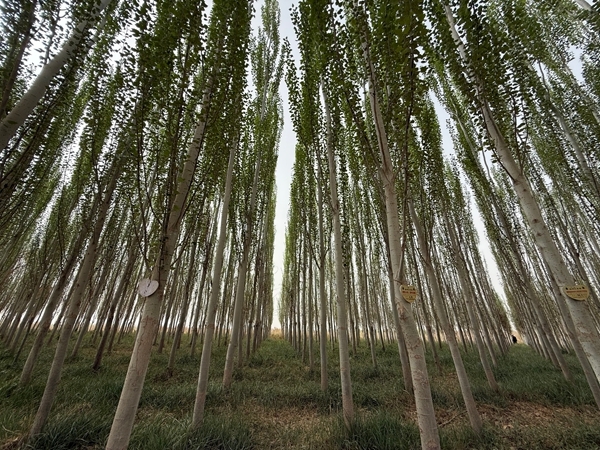
Shelterbelt forest afforestation site in Maigaiti County [Photo/Zhao Xiaopeng]
From encroaching sands to a green barrier
A decade ago, desertification posed an existential threat to Maigaiti County. Surrounded by desert on three sides, the area experienced more than 150 days of sandstorms annually, with dunes advancing to within five kilometers of the county seat.
In 2012, local authorities launched a large-scale afforestation project. Since then, more than one million mu (around 66,700 hectares) of land has been treated through a combination of engineering, ecological restoration, and industrial approaches. The effort has produced a green belt approximately 55 kilometers long and up to 4 kilometers wide, shielding the oasis from further desert expansion.
The transformation did not happen overnight, with several pivotal phases throughout the process.
“In peak years such as 2017 and 2022, 70,000 mu of land was afforested annually, with 10,000 volunteers nationwide joining tree-planting efforts. They received financial support, including meal and transportation allowances,” said Yin Honghai, director of the local desert prevention and control center.
During other periods, 10,000 to 30,000 mu of trees are planted each year based on local conditions.
“It was impossible to achieve an 80 percent survival rate in the early stages,” Yin noted. “We had to learn from our failures, consult experts, and gradually gain an understanding of the needs of each plant species.”
Today, the survival rate has surpassed 85 percent, thanks to land leveling, suitable species selection and optimized water management. The main adaptive tree species selected for local afforestation include poplars, oleasters and saxauls.
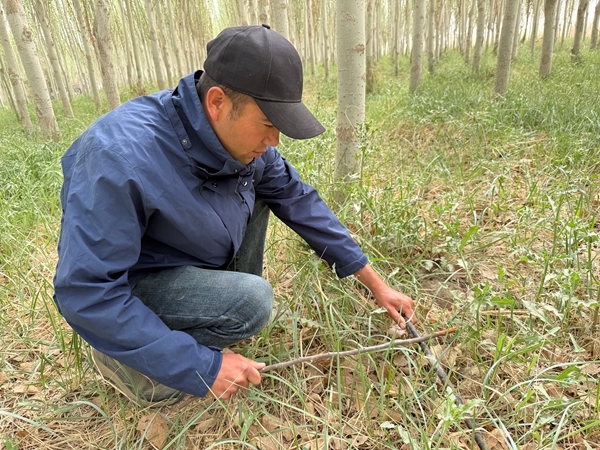
Forest rangers clearing drip irrigation pipelines [Photo/Zhao Xiaopeng]
Drip irrigation is adopted as a core technical measure, guaranteeing adequate water supply for each tree amid extremely scarce annual precipitation, which has historically stood at around 50 millimeters.
The project also generates economic returns. Local authorities have developed an under-forest economy, featuring the cultivation of medicinal herbs and drought-resistant crops. In some areas, land has been leased to enterprises, while ecological compensation and government subsidies help sustain operations.
Besides, the initiative has created jobs. Around 340 local residents are employed in the daily shelterbelt maintenance team, receiving regular income alongside additional seasonal job opportunities.
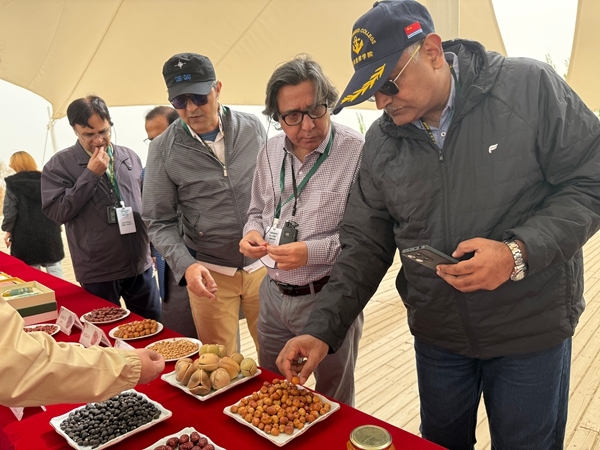
Delegation members sampling desert fruits grown in the ecological forest [Photo/Zhao Xiaopeng]
Pakistani perspective: inspiration meets constraint
At first glance, Pakistan’s desert regions may appear more challenging than those in northwest China. But in some respects, the opposite may be true.
Unlike the Taklimakan Desert, often described as a “Sea of Death” due to its extreme aridity and highly mobile dunes, the Thar Desert benefits from relatively higher rainfall and seasonal monsoon patterns, and the region has long supported human settlement, agriculture, and livestock grazing.
Yet these advantages have not translated into large-scale ecological restoration.
The challenge in Thar is less about stopping an advancing desert, and more about managing a fragile, inhabited ecosystem under stress. Erratic rainfall, water storage, and pressure from human activity have contributed to land degradation, even where natural conditions might support vegetation.
For Pakistani observers, this raises a deeper question: if afforestation can succeed under harsher natural conditions in China, why has progress been slower in a comparatively less extreme environment?
“Pakistan’s desert regions, including the Thar Desert, face more extreme temperature fluctuations and persistent water constraints,” said Shaheer Ahmad, Research assistant at Centre for Aerospace and Security Studies, noting that groundwater is often deep and difficult to access.
He also pointed to structural barriers: limited infrastructure, weak connectivity, and bureaucratic obstacles. “These are systematic issues, not limited to deserts,” he said.
Another delegate, Adnan Iftikhar, Editor sub news media house, emphasized the importance of political commitment. “First, we need the vision,” he said. “Financial and technical issues come later.”
While awareness of climate change is growing in Pakistan, he suggested that practical implementation is urgent now.
What can and cannot be transplanted
The Pakistani delegates returned home without a without a one-size-fits-all blueprint. What the visit provided, delegates said, was a clearer picture of what the components of a serious desert management program look like, and a more precise understanding of which of those parts remain absent at home.
The Maigaiti County model depends on centralized planning, massive state investment, and a level of administrative coordination that reflects conditions specific to China. Attempting to copy it wholesale would likely fail.
But selective adaptation is a different matter. The technical knowledge accumulated in Maigaiti County — about species selection, drip irrigation in extreme aridity, dune stabilization, and the economics of under-forest cultivation — is potentially applicable in a variety of contexts. None of it requires the same political system to work.
Pakistan, moreover, is not starting from nothing. Federal and provincial governments have, over the past decade, launched afforestation campaigns, tree-planting initiatives, and programs to improve water management and agricultural resilience in degraded lands. Progress has been uneven, constrained by funding gaps and the difficulty of coordinating across diverse ecological and administrative contexts. But the knowledge and the institutions, however imperfect, exist.
(Editor: fubo )