


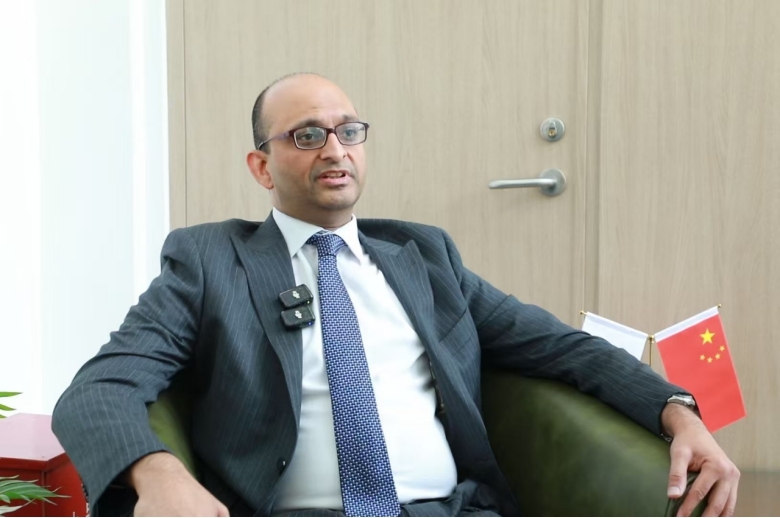
Farhan Talib, Head International of HBL, in interview with China Economic Net [Photo/ Zhang Peng]
by Xiong Weisheng
BEIJING, May 16 (China Economic Net) — Pakistan’s first Panda Bond has opened a lower-cost yuan funding channel that may help the country diversify beyond traditional dollar and euro borrowing, an HBL official told China Economic Net on Friday.
The RMB 1.75 billion, or about $250 million, issue was priced at 2.5 percent, marking Pakistan’s debut in China’s domestic bond market.
“The pricing guidance was 2.5 percent,” Farhan Talib, Head International of HBL, told China Economic Net in an exclusive interview. “That is perhaps the lowest rate at which Pakistan has ever been able to raise money from capital markets.”
Talib said the transaction gives Pakistan an alternative to traditional dollar- and euro-denominated borrowing and creates a basis for future issuance in yuan.
Pakistan may return to the Chinese bond market soon after the debut issue, with discussions already under way on a possible follow-up transaction that could come within three to six months, he said.
“It is not about doing this one time,” Talib said. “It is about coming to this market again and again, on a needs basis and on an opportunity basis.”
HBL, which operates branches in Urumqi and Beijing, served as financial adviser for the transaction alongside CICC after receiving the mandate from Pakistan’s Ministry of Finance in 2019.
Talib said HBL helped structure the deal, coordinate with partners and support regulatory approvals from the National Association of Financial Market Institutional Investors and the People’s Bank of China.
The bond was backed by a 95 percent guarantee from the Asian Infrastructure Investment Bank and the Asian Development Bank, helping improve its rating and lower funding costs, he said.
For Pakistan, the deal brings a new class of Chinese investors into the country’s financing base. Those investors will now follow the bond’s performance and monitor Pakistan’s performance, Talib said.
The first issue could also encourage Pakistani companies with stronger balance sheets to consider raising funds in China, particularly those with stable cash flows, consistent earnings and a sufficient operating track record.
“For companies with consistent revenue streams and consistent profitability, certainly,” he said, adding that bond investors usually look at an issuer’s past performance.
The Panda Bond route may also become relevant for future projects under the next phase of the China-Pakistan Economic Corridor, depending on project structure, cash flows and financing needs, Talib said.
It could give Pakistani and Chinese companies another option beyond traditional SINOSURE-backed financing as CPEC expands into industry, agriculture and technology, he said.
HBL opened its first China branch in Urumqi in 2017 and its Beijing branch in 2021. Talib said the bank will continue to support Pakistan-China financial links through yuan financing, trade settlement and advisory services.
(Editor: fubo )