


by Wang Kai
A cohort of 25 Pakistani students has arrived at Wuhan Technical College of Communications in central China for a year-long programme in cross-border e-commerce, artificial intelligence, and Chinese language studies, as bilateral institutions are stepping up pace to seize opportunities in Pakistan’s rapidly expanding digital economy.
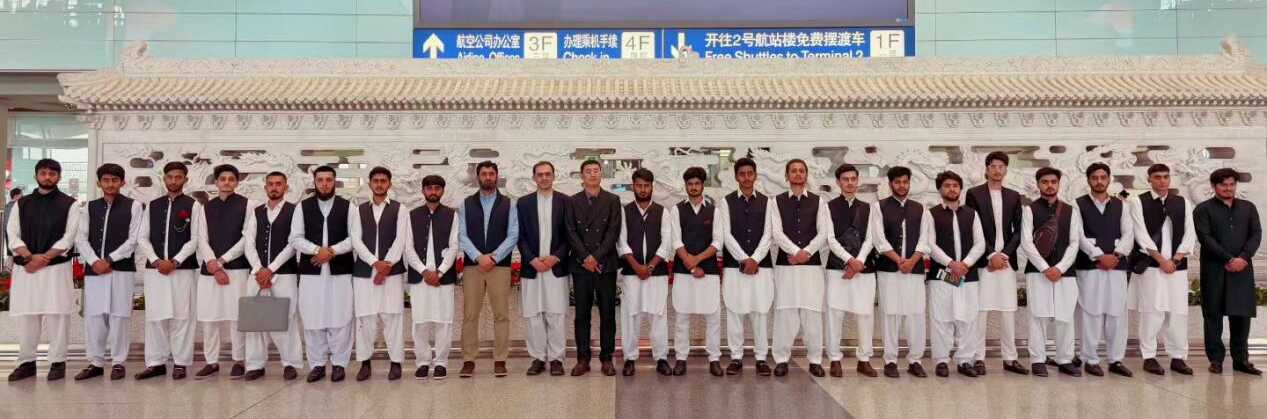
A total of 25 Pakistani students has arrived at Wuhan Technical College of Communications in central China for a year-long programme in cross-border e-commerce, artificial intelligence, and Chinese language studies. Picture provided by Tang International.
Driven by rising internet penetration and accelerating digital adoption, Pakistan’s e-commerce sector is undergoing a transformative surge. In the second quarter of fiscal year 2026, digital payments accounted for 92% of retail transactions in Pakistan, according to the State Bank of Pakistan (SBP). Statista projects that the number of e-commerce users in Pakistan to reach 14 million by 2029, with internet penetration expected to climb to 92.2% and industry revenue forecast to grow at a compound annual rate of approximately 5.92%.
A young population, coupled with the addition of nearly two million people to the labour force each year, provides fertile ground for digital services, high-frequency consumer spending, and internet-based products. According to the Pakistan Telecommunication Authority, the country had 150 million internet users in 2025. Internet banking has continued to gain momentum, with transaction volume and value rising by 11% and 22%, respectively, in the second quarter of fiscal year 2026. This month, the National Bank of Pakistan further accelerated the country’s digital finance push by launching its new digital payment platform, NBP SmartPay.
Closer B2B Connection
“To further boost Pakistan’s exports through digital channels, it is imperative to address the mismatch between supply and demand,” said Leo, founder of the Silk Road Assistance Industrial Internet Platform.
He said the company is advancing the establishment of forward warehouses, showrooms, and factories in Pakistan. “We are building localized industrial bases in Pakistan to bring together trade and financial enterprises within these industrial clusters,” he said.
He noted that apart from enhancing trade efficiency, the project could generate GDP growth, tax revenue, and employment opportunities for Pakistan, while also advancing local industries. “Through our operational networks across various provinces and cities in China, Pakistani suppliers will be able to connect and transact with Chinese buyers and suppliers within seconds through digital channels,” he envisions.
TDD Global, another major e-commerce platform from China, inaugurated its digital economy headquarters in Pakistan this month and signed 21 memorandums of understanding aimed at promoting bilateral digital trade cooperation.
“This year, we will organize industry-focused B2B roadshows in multiple cities across Pakistan and use digital platforms to achieve intelligent matching between supply and demand,” said Daniel, a general manager at the company. “The goal is to enable Pakistani enterprises to connect with high-quality Chinese suppliers without leaving their homes.”
The AI Upgrade Behind Online Retail Boom
According to PCMI, the number of registered e-commerce merchants in Pakistan increased by 427% between 2019 and 2023. Yet it is imperative to improve their online storefronts and digital presentation to better compete in international markets, Zhao Zhijiang, a former e-commerce training instructor at National University of Sciences and Technology, suggested.
Leo said his company plans to bridge that gap through AI-powered digital tools. “We will open up our AI platform to Pakistani users, enabling freelancers and businesses to quickly build independent websites and generate content with just one click. After our forward warehouses are established in Pakistan, we will train a large number of local live-streamers to promote their products.”
Distribution of e-commerce packages is another area that AI is reshaping. Haseeb Ansari, Supply Chain & Operations Expert at Leopards Courier Service Pvt Ltd: In Pakistan, the "last mile" is often the most expensive and complex part of the e-commerce journey, accounting for over 50% of total shipping costs.
In partner with Chinese companies, Pakistan has come to the frontier of intelligent parcel sorting, with automated parcel sorting centres for Daraz in Karachi and Lahore built by Cainiao, China’s e-commerce giant.
“Previously, sorting process was entirely manual,” said Muhammad Usman Chohan, an engineer at Daraz. “Workers had to scan barcodes and sort parcels by destination. With the automated system, parcels are simply placed into the machine, where cameras scan and sort them automatically with extremely high efficiency.” Parcel mis-sorting rates had fallen from around 1% to below 0.03%.
Usman Qureshi, the project manager, said the automated system has reduced sorting time dramatically. “Tasks that previously required four hours can now be completed within one hour,” he said. “The system has also expanded cargo circulation capacity and made the entire delivery process much smoother, significantly improving delivery efficiency.”
Training Pakistan’s E-generation
The Chinese model of fostering industrial development through competition is also being introduced to Pakistan. In 2025, the China Pakistan TVET Industrial Center of Excellence successfully brought one of China’s leading national e-commerce competitions — the China E-commerce Livestreaming Competition — to Pakistan. The event attracted more than 500 teachers and students from over 20 Pakistani universities and institutions.
The competition focused on uncovering the stories of Chinese and Pakistani handicraft masters while promoting local culture through livestream commerce. Outstanding participants were selected for customised training programmes in China.
“Many students who received training in these specialised technologies are now securing strong opportunities in both Chinese and Pakistani institutions, while others are becoming self-entrepreneurs promoting Pakistani products,” said Muhammad Ammar, secretary-general of China-Pakistan International Industrial Academic Integration Alliance.
He noted that although Pakistan has established multiple national pavilions in China, many still lack high-quality products and skilled talent capable of operating in the digital marketplace. “By cultivating students with strong Chinese-language abilities, AI knowledge, and expertise in modern cross-border e-commerce techniques, we are helping them build not only a solid footing in Pakistan, but also access to broader national-level platforms in China,” he said.
According to Ummar, the organisation is deepening cooperation with Chinese e-commerce industrial zones and enterprises in Hainan, Wuhan, Qingdao, and other major cross-border e-commerce hubs. The goal is to integrate Chinese industrial resources into Pakistan’s education system and establish local operational bases.
“In 2026, we plan to develop industry-education integration bases dedicated to e-commerce and cross-border trade,” he said. “By establishing specialised training centres within Pakistani universities, we aim to cultivate a complete e-commerce ecosystem in Pakistan and equip students with the skills needed for the digital economy.”
(Editor: wangsu )