

by Wang Kai
From Gwadar's China-Pakistan Friendship Hospital which has treated over 350,000 patients since opening, to the screening of Pakistan's highest-grossing film in Chinese cinemas; from Pakistan's first driverless rapid transit train shuttling in Lahore that carries over 300,000 passengers daily in April, to the training of Pakistan’s first astronaut for China’s space station mission... As Beijing is to welcome the visit by Pakistan's Prime Minister later this week, one of the most enduring bilateral relationships in modern times and arguable the most important foreign relations for Pakistan is set to renew with refreshed vigor after 75 years of close partnership.
The year 2026 is one of expanded investment outreach and commemoration designated by both countries. What began with highways, ports and power plants is leaving growing imprint on Pakistan’s industrial transformation and economic modernisation, and more importantly, seeping into ordinary Pakistani people’s life: energy spending saved, difficult illnesses cured, high-paid jobs landed, better products acquired, to name a few.
For 12 consecutive years, China is Pakistan's largest trade partner. Over 7.4% of Pakistan’s goods find its consumers in Chinese market in FY 24-25; in the first quarter this year, Pakistan's exports to China rose 44.79% from a year earlier.
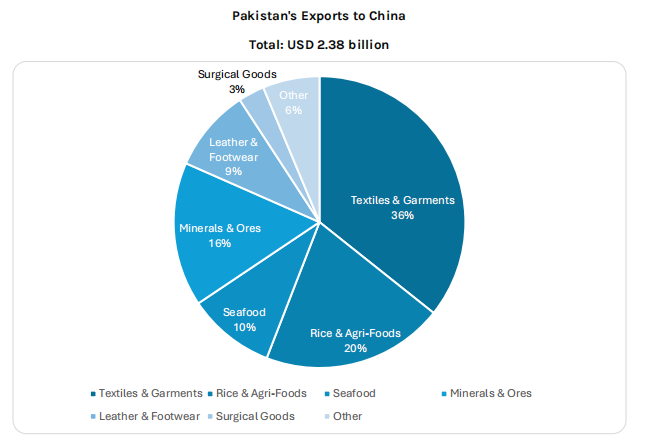
Pakistan’s exports to China reached USD 2.38 billion in fiscal year 2024–25. The first phase of the China–Pakistan Free Trade Agreement, launched in 2007, helped expand bilateral trade by 242 percent over the following decade. Under Phase II, which came into force in 2020, China removed tariffs on 313 priority Pakistani product lines, while both sides agreed to liberalise 75 percent of tariff lines. Source: SDPI.
A greener, more self-sustaining economy
Few transitions in any developing economy in the past decade match the speed of Pakistan’s solar uptake. Cumulative solar PV imports from China between 2019 and mid-2025 reached approximately 36 GW, a volume that, on paper, exceeds three-quarters of Pakistan’s installed power-generation capacity, as per World Resources Institute. Lithium battery imports from China rose by approximately 68 percent in the first half of 2025 alone, enabling household and SME storage and effectively democratising electricity access.
While shielding Pakistani consumers from soaring international fuel prices, an increasingly localised value chain is accelerating the country’s industrialisation. Researchers at National University of Sciences and Technology argue that Pakistan’s special economic zones offer the structural foundation for solar localisation under CPEC 2.0. Their feasibility assessment identifies three sequential opportunities: first, module assembly using imported cells, achievable within 12–24 months at SEZ sites with reliable power supply; second, cell fabrication using imported wafers, requiring 24–48 months and an estimated USD 200–400 million in capital expenditure per production line; and third, full polysilicon-to-panel integration, which could take 48–96 months and demand cumulative investment of roughly USD 1.2–2.0 billion. At each stage, greater value is added domestically while dependence on imports steadily declines.
The same logic applies to battery energy storage. The peer-reviewed literature on battery-manufacturing learning curves suggests that Pakistani entry into cell-pack assembly within the 2026-2028 window could capture approximately 40 percent of the global battery energy storage cost-reduction trajectory through scale and learning effects.
Pakistan is also transforming from an importer to a production hub of electric vehicles, aligning with its target of 30 percent EV penetration in new vehicle sales by 2030, and 90 percent by 2040. Cumulative installed local manufacturing capacity for electric two- and three-wheelers had reached approximately 2 million vehicles per annum by March 2025, with 58 manufacturing certificates issued and 9 certificates for three-wheeler production. Chinese OEMs, BYD, Changan, JAC, Great Wall Motors, MG, FAW, Chery, and Yadea, have moved decisively to establish presence. BYD has obtained manufacturing licences and is partnering with Mega Motors to produce the BYD Atto 3 and Sealion in Pakistan. Changan and JAC have CKD assembly operations. Last year, EV two-wheeler sales in Pakistan surged by 191 percent year-on-year, reaching approximately 90,000 units, a remarkable trajectory in a market that was effectively zero in 2023.
FDI: Behind Headline Numbers
From July 2025 to February 2026, China contributed 53.2% of the foreign direct investment (FDI) inflows into Pakistan. The Pakistan Business Council’s data confirm that more than 60 Chinese companies registered new manufacturing entities in Pakistan during 2024-2025, a step-change from the pre-2020 average of approximately 15-20 new registrations per year.
“The ‘debt-trap’ framing of CPEC, while politically resonant in some Western analyses, does not survive disciplined examination of the data,” a research by Sustainable Development Policy Institute (SDPI) notes. As of mid-2025, Pakistan’s external debt stood at approximately USD 131 billion; of this, debt to Chinese institutions, including SAFE deposits, currency-swap-converted obligations, China EXIM Bank concessional loans, and CDB commercial loans, represents roughly 22 percent, according to data from Equilibrium and IMF. Crucially, this debt is concessional in character, with average effective interest rates in the 2.5-3.5 percent range, materially below sovereign Eurobond yields that have ranged from 8 to 14 percent over the past decade, and the empirical record shows multiple instances of debt rollover, restructuring, and currency-swap renewal at Pakistan’s request. The IPP capacity payment problem is real and consequential, but it is a contractual-design issue that can be traced to the last century, not a sovereign debt issue.
The most cited quantitative assessment of debt risks attributed the concern to Pakistan’s broader IMF-recidivist macroeconomic profile. Boston University’s Global Development Policy Center have similarly documented that Chinese policy-bank lending to Pakistan has been characterised by repeated forbearance and repayment flexibility, behaviour inconsistent with strategic-coercion theses. The IMF’s Pakistan country-team analysis explicitly notes that Chinese lending’s structural features, long tenors, fixed concessional rates, project-tied disbursement, have provided macroeconomic stability during multiple Pakistani balance-of-payments episodes. The verdict the empirical record supports is that the more apt frame for analysis is not “debt trap” but “debt-equity-tariff complex”, a triadic structure in which the principal binding constraints are tariff design and project equity returns, not sovereign creditor coercion.
For Pakistani, the more pressing concern is its persistent vulnerability to dollar liquidity shocks, as seen in the balance-of-payments crises of 2008, 2018, 2022 and 2023. “The global movement toward multipolar payments architecture is strategically relevant rather than merely fashionable,” the SDPI research notes.
The report suggests Pakistan striving for deeper engagement with RMB systems for multipolar hedging. China’s Cross-Border Interbank Payment System (CIPS) processed approximately RMBequivalent USD 245 trillion in transactions during 2025, providing an operational settlement alternative to dollar-denominated SWIFT channels. Project mBridge, the multi-CBDC platform, has processed approximately USD 55.5 billion in cross-border transactions across more than 4,000 settled trades, with 95 percent denominated in digital yuan. “Pakistan’s direct CIPS connectivity, currently routed through correspondent Chinese banks, can be deepened through a dedicated SBP-PBoC arrangement modelled on the Saudi-PBoC framework. Pakistan, as a non-BRICS observer, should pursue technical-observer status on mBridge, with an eye to operational connectivity for CPEC-linked trade flows,” the report suggests.
Beyond 75 years
By mid-2025, CPEC delivered approximately 8,000 MW of new generation capacity, 510 km of motorways, the rebuilt Gwadar Port, and 261,000 direct jobs.
The torch of hope is being carried on. Approximately 28,000 Pakistani students were enrolled in Chinese institutions, ranking among the top countries globally in both the absolute number of students studying in China and recipients of Chinese government scholarships. Co-authored peer-reviewed publications in indexed journals have grown from approximately 400 per year in 2010 to over 4,500 per year in 2025, making China the single largest research-collaboration partner for Pakistani academia.
“Pakistan’s national economic transformation plan, formally launched in January 2025 with a horizon to 2029 and a vision for a USD 1 trillion economy by 2035, provides the most coherent domestic strategic architecture in recent decades, and embedding bilateral cooperation within that framework ensures that Pakistan-China engagement reinforces national priorities,” the SDPI research stresses.
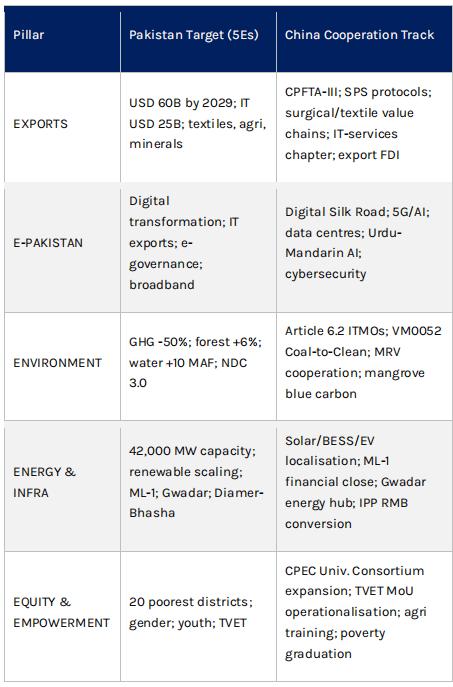
Mapping each pillar of Uraan Pakistan to specific China-cooperation tracks. Graph from SDPI.
Looking ahead, three convergence vectors comes to the forefront. First, the Trans-Afghan extension of CPEC, formally agreed in the China-Pakistan-Afghanistan trilateral of May 2025, opens Central Asian connectivity at a moment when Russian and Iranian routes face friction. Second, Gwadar’s evolution into a regional energy and trans-shipment hub, including potential LNG re-export and greenhydrogen export capacity, can absorb Gulf and Central Asian feedstocks in ways Karachi cannot. Third, Pakistan’s SCO chairship in 2026-2027 provides the multilateral platform to lock in connectivity standards, customs harmonisation, transit protocols, digital-payment interoperability, that will outlast any single political administration in either country.
(Editor: wangsu )