


By Zafar Hussain
BEIJING, Jun 2 (China Economic Net) -- As China's demand for high-quality and nutritious food products continues to grow, Pakistani pine nuts are emerging as a promising export with significant market potential. Harvested from the pristine mountainous regions of northern Pakistan, these premium nuts are renowned for their rich flavor, high nutritional value, and natural cultivation methods. Despite their superior quality and geographical proximity to China, Pakistani pine nuts currently account for only a modest share of China's rapidly expanding premium nut market.
Pakistan's chilgoza (pine nut) forests are concentrated in North and South Waziristan, along with parts of Balochistan, Khyber Pakhtunkhwa, and Gilgit-Baltistan. According to Amjad Zarin, Associate Professor at Jilin International Studies University, North and South Waziristan contribute around 80–85 percent of the country's total pine nut output. North Waziristan produces an estimated 1,700–2,000 metric tons annually, while South Waziristan adds 800–900 metric tons. Pakistan's overall chilgoza production typically ranges between 2,100 and 2,900 metric tons per year, with higher yields possible under favorable weather conditions, he told China Economic Net (CEN).
China Becomes Pakistan's Most Important Market
Chinese demand for Pakistani pine nuts has surged over the past few years, driven by rising consumer interest in healthy snacks and premium imported food products.
According to data from The General Administration of Customs of the People's Republic of China (GACC), Pakistan's pine nut exports to China nearly doubled between 2023 and 2025.
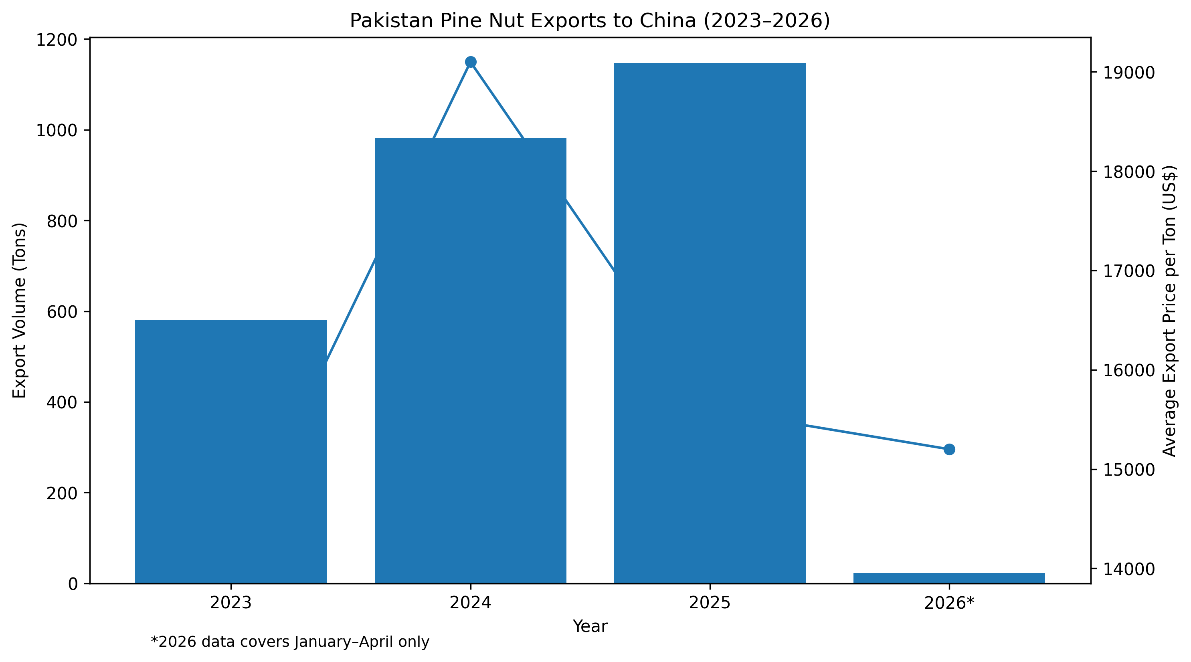
Pakistan's Pine Nut Exports to China
Abdul Mateen, CEO of AM Enterprises, told China Economic Net that his company has been exporting Pakistani pine nuts to China for the past 12 years. He noted that Chinese consumers highly prefer Pakistani chilgoza due to its thin shell, crispy texture, and mild flavor. According to traders, nearly 80–90 percent of Pakistan's pine nut exports are now destined for the Chinese market.
According to data from China's General Administration of Customs (GACC), Pakistan's pine nut exports to China recorded robust growth between 2023 and 2025, with export volumes nearly doubling from 579.8 tons to 1,147 tons. Export earnings surged from $8.2 million in 2023 to a peak of $18.8 million in 2024 before easing slightly to $17.9 million in 2025.
Abdul Mateen, working closely with China since 2014, says China and Pakistan have significant room to deepen cooperation in agricultural processing and value-added exports. Key areas include modern cleaning and sorting systems, dehydration technology, roasting and deep-processing facilities, advanced packaging, and cold-chain logistics. Such collaboration could enhance product quality, extend shelf life, reduce post-harvest losses, and help Pakistani exporters develop premium retail products for global markets. Expanding e-commerce cooperation would also give Pakistani pine nuts wider access to Chinese consumers and strengthen bilateral agricultural trade.
Rising Prices Reflect Strong Demand
Pine nut prices inside Pakistan have risen sharply over recent years due to strong global demand. According to local traders, Pine nuts prices in Islamabad range between PKR 4,500 and 8,000 per kilogram in 2025-2026, while export-quality nuts can fetch up to PKR 12,000 per kilogram. Abdual Mateen told that within China the average price was RMB 130 per KG in 2025.
Amjad told CEN that in Wana Bazaar, prices were from around PKR 2,200–2,500 per kilogram in 2025 to nearly PKR 2,700 during winter due to seasonal demand and almost same this year so far.
Industry experts regard China as the most promising export destination for Pakistani pine nuts, supported by its vast consumer base and rising demand for premium imported foods. Despite the product's high quality, Pakistan's pine nut sector faces challenges including limited processing facilities, inadequate packaging, and inconsistent quality standards.
Experts believe that stronger cooperation with Chinese investors, food-processing companies, and e-commerce platforms could help modernize the industry and increase value-added exports. Improved processing, branding, certification, and supply chain management would enable Pakistani pine nuts to compete more effectively in China's premium nut market.
(Editor: liaoyifan )