


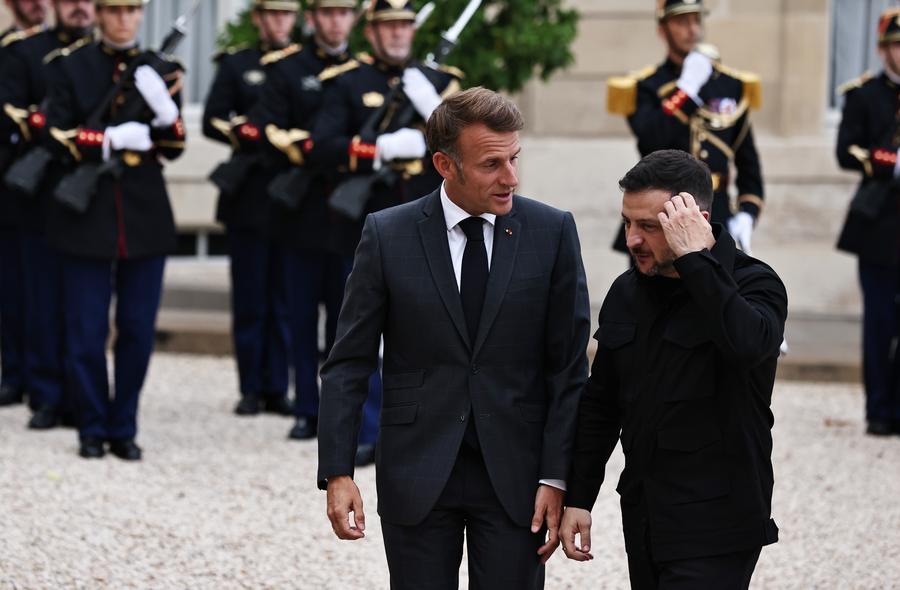
French President Emmanuel Macron (front L) greets Ukrainian President Volodymyr Zelensky at the Elysee Palace in Paris, France, Sept. 3, 2025. (Xinhua/Gao Jing)
While Europe has welcomed U.S. efforts to broker peace, it is also uneasy about where these efforts may lead.
BRUSSELS, Dec. 2 (Xinhua) -- Intensive talks on a plan aimed at ending the Russia-Ukraine conflict have kicked off involving the United States, the European Union, Ukraine and Russia. However, although European leaders have welcomed diplomatic efforts to end the almost four-year conflict, there is also significant unease over the U.S.-proposed peace plan.
LATEST PROGRESS
The plan at the center of the debate started as a 28-point proposal drawn up by the Trump administration and presented to Ukraine and its European allies in recent weeks.
The original draft required Ukraine to give up control of some territory, abandon its bid to join the North Atlantic Treaty Organization (NATO), accept limits on the size of its armed forces, and restrict any future NATO presence on its soil. It drew sharp criticism in Ukraine and across Europe, with many saying the plan ceded too much to Russia's demands.
Facing that backlash, the United States and Ukrainian negotiators met in Geneva, and cut the framework down from 28 points to a shorter outline. Some reports said that Britain, France and Germany have also led work on a "European version" of the 28-point plan.
On Sunday, the United States and Ukrainian teams held a new round of talks in Florida. Speaking in Paris on Monday, Ukrainian President Volodymyr Zelensky said the revised plan "looks better" than the first version but added that negotiations are far from over. He called topics over territory "the most complicated" part of the talks.
On Tuesday, U.S. special envoy Steve Witkoff arrived in Moscow to brief Russian President Vladimir Putin on the updated text, ushering in a new phase of negotiations.
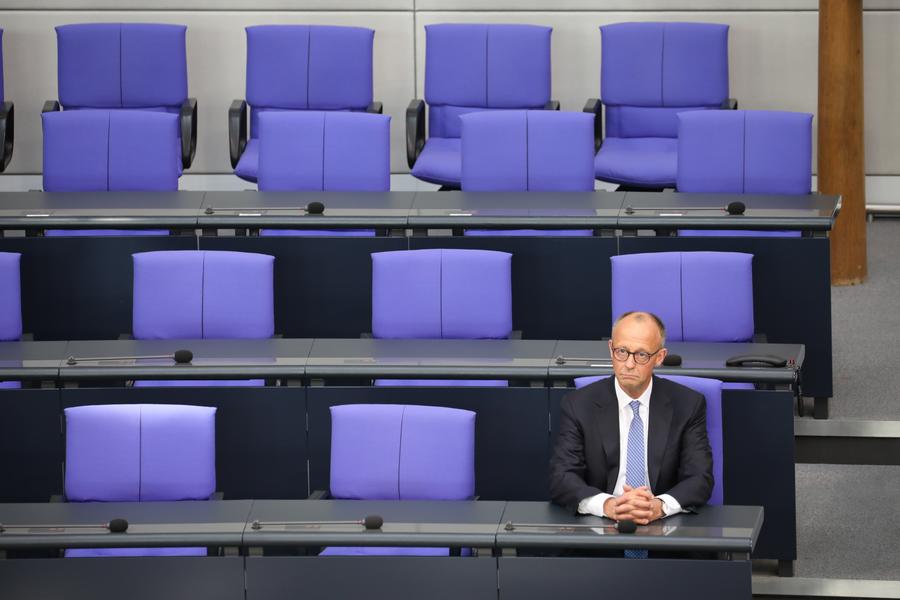
Friedrich Merz, leader of Germany's conservative Christian Democratic Union (CDU), sits in the chancellor's seat after taking the oath at the Reichstag building in Berlin, Germany, on May 6, 2025. (Xinhua/Du Zheyu)
WHY EUROPE IS WORRIED
Europe's stance on the Ukraine "peace plan" has been nuanced. While it has welcomed U.S. efforts to broker peace, it is also uneasy about where these efforts may lead.
Last week, the European parliament criticized the United States for its "political ambivalence" on Ukraine policy, saying it was "detrimental to the goal of lasting peace."
Meanwhile, Finnish Foreign Minister Elina Valtonen on Saturday expressed concern that Ukraine could be "led into a situation where it would have to accept the terms of peace given to it."
"I'm afraid that all the pressure will be put on the victim," European Union foreign policy chief Kaja Kallas told reporters after chairing a meeting of EU foreign and defense ministers on Monday. "Because that is the easier way to stop this war, when Ukraine surrenders. But this is not in anybody's interest."
Beyond the substance of the plan, Europe is also worried about its own role in the talks. The first U.S. draft was largely developed with many EU countries feeling blindsided.
European Commission President Ursula von der Leyen reiterated last week at the European parliament that nothing about Ukraine should be decided without Ukraine, nothing about Europe without Europe and nothing about NATO without NATO, a formula meant to signal that Europe will not accept a settlement negotiated over its head.
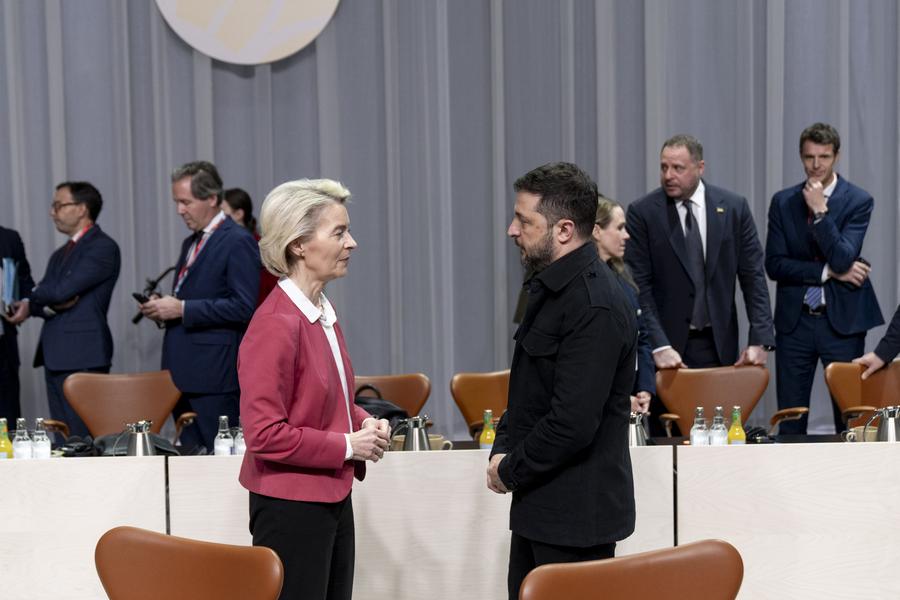
European Commission President Ursula von der Leyen (Front, L) speaks with Ukrainian President Volodymyr Zelensky (Front, R) during the seventh meeting of the European Political Community (EPC) in Copenhagen, capital of Denmark, Oct. 2, 2025. (Photo by Anders Kongshaug/Xinhua)
WHAT EUROPE PLANS TO DO
To exert maximum influence over the terms of the deal and reinforce Ukraine's position, Europe is fighting for a seat at the negotiation table. The EU wants to ensure that the principles of European security are written into any peace arrangement, and that Ukraine receives stronger security guarantees, increased military aid and new financial tools.
French President Emmanuel Macron, standing alongside Zelensky in Paris on Monday, praised the U.S. peace efforts but insisted that any peace plan can "only be finalized with Europeans around the table."
At the same time, the EU and several member states are working on bilateral and multilateral agreements with Ukraine, covering air defense, ammunition supply, and training.
On the military side, the Netherlands has pledged 250 million euros (about 290 million U.S. dollars) in aid to Ukraine on Monday for purchasing American-made weapons under a NATO mechanism.
Money is another key lever. The European Commission has proposed using frozen Russian assets held in Europe as collateral for a 140-billion-euro "reparations loan" to Ukraine. However, Belgium, where much of the money is parked, has raised legal and financial concerns over this proposal, forcing EU leaders to push a final decision to a summit later this month.
As the U.S. envoy sits in Moscow, Europe is still scrambling for a say, hoping that it will have greater sway over the final terms of peace. (1 euro = 1.16 U.S. dollars)
(Editor: fubo )