


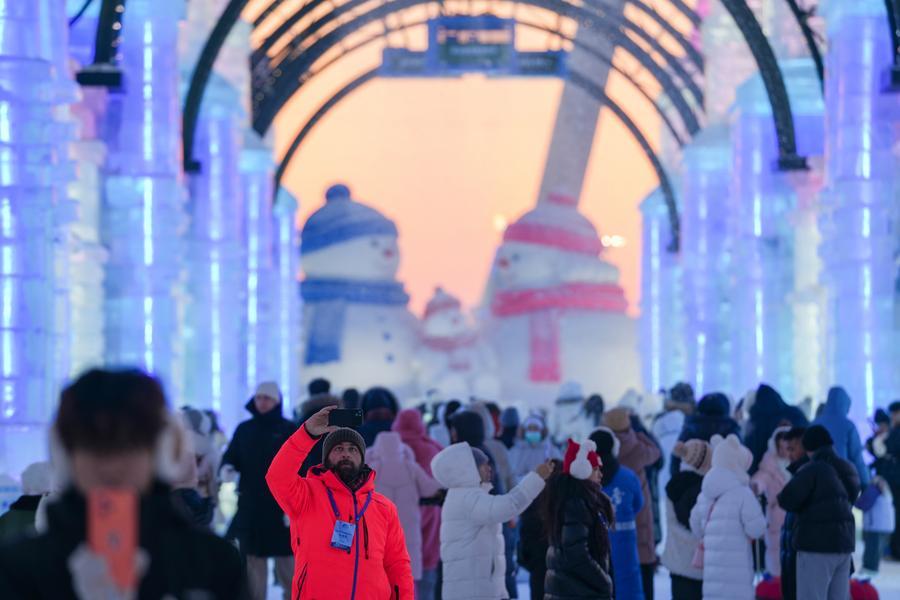
People visit the Harbin Ice-Snow World in Harbin, northeast China's Heilongjiang Province, Jan. 5, 2026. (Xinhua/Wang Jianwei)
HARBIN, Jan. 8 (Xinhua) -- CNN correspondent Mike Valerio rang in the New Year among throngs of visitors at Harbin Ice-Snow World, braving sub-zero temperatures to showcase what he described as the "largest winter festival in the world" to audiences worldwide, underlining that this city has become yet another glitzy attraction boosting travel to China from locations around the world.
For many in the West, the name Harbin may not immediately ring a bell. The capital city of northeast China's Heilongjiang Province is often associated with China's old industrial base, where smokestacks and factory rooftops dominated city views.
Through Valerio's lens, however, that image was thoroughly erased and replaced by a dazzling skyline of towering ice sculptures and glowing lanterns.
As the world's largest ice-and-snow theme park, Harbin Ice-Snow World stands as a prism reflecting the city's ongoing transformation. Once challenged by industrial restructuring, the region's steel and minds now underpin the wonders of its iconic winter attractions, channeling renewed momentum fueled by a surge of global visitors.
Inspired by the CNN broadcast, Brazilian tourist Samy Klajman flew thousands of kilometres to experience China's winter, turning his summer in the Southern Hemisphere into a surreal northern adventure.
Gazing up at six-story ice sculptures, Klajman described the trip as "the craziest -- but definitely worthwhile." He said Harbin's blend of vivid aesthetics and modern technology was among the biggest surprises encountered on his visit.
"It feels like a city from the future," he said, while filming dancing humanoid robots and drone performances against an illuminated replica of the ancient Yellow Crane Tower. "I never thought winter could become such an unprecedented carnival."
Few visitors realize how quickly this spectacle takes shape. From Nov. 25 to Dec. 17 last year, about 10,000 workers, aided by automated ice-cutting machines and heavy industrial equipment, shaped 400,000 cubic meters of ice and snow into a 1.2-million-square-meter winter wonderland.
The massive operation is repeated annually, drawing millions of domestic and overseas visitors.
Among them was Papawarin, a tourist from Thailand, who shared her excitement with family moments after racing down the park's iconic 521-meter Super Ice Slide.
This was the first time she had ever seen so much ice and snow, not to mention molding it into shining hills and slide lanes, Papawarin revealed. "I'm going to tell all my friends how cool China is in winter."
Beyond the spectacular scenery, new attractions powered by emerging technologies are enriching the visitor experience in Harbin.
Guo Hongwei, chairman of Harbin Ice and Snow World Co., Ltd., said the park has introduced augmented-reality performances, immersive indoor shows supported by 4D and virtual reality technologies, as well as AI-assisted guidance. A 5,000-square-meter air-supported dome has also been added to enhance visitor comfort.
"We aim to offer a grand ice-and-snow carnival through ever-improving services," Guo noted.
The popularity of Harbin's winter attractions is translating into strong economic returns. During the three-day New Year holiday this month, inbound tourist visits to the city surged 77.9 percent year on year, while inbound tourist spending increased by 88.1 percent. Total tourist consumption reached 5.56 billion yuan (roughly 79.2 million U.S. dollars).
This momentum extends far beyond tourism. Amid the winter travel boom, Harbin recently hosted its inaugural Harbin International Ice and Snow Expo and a Global Mayors Dialogue, which brought together diplomats, city representatives, business leaders and experts from over 20 countries and regions, keen to explore opportunities in what some describe as "Cool China."
"Harbin's distinctive cultural heritage and ice-and-snow appeal continue to draw global attention," said Emmanuel Loriot, consul general of the French Consulate General in Shenyang, capital of Liaoning Province, which is also in northeast China. Loriot added that he plans to lead a delegation of more than 60 French companies to Harbin later this year to explore cooperation in cultural tourism, high-end manufacturing and other sectors.
Heikki Kontiosalo, deputy speaker of the city council of Rovaniemi in Finland, said he was impressed by China's evolving winter equipment, ranging from industrial-grade unmanned snow-removal machines to carbon-fiber skis.
"These products show how ice and snow have evolved from a natural resource into a powerful driver of innovation and business," he explained.
With China continuing to optimize its visa-free policies and boost the supply of high-quality goods and services, the country's ice-and-snow economy is benefiting, exceeding 1 trillion yuan in scale in 2025, China Tourism Academy said in a report.
Transforming from seasonal festivals to a fully-fledged economic engine, China's ice-and-snow resources are reshaping consumption, energizing industries and redefining urban governance, while showcasing a dynamic, enterprising and hospitable China to both its citizens and the world, said Han Yuanjun, a researcher at the academy.
"The popularity of Harbin has largely overturned the stereotype of northeast China, with a region once seen as dusty and declining now presenting itself to the world as dynamic, progressive and welcoming," said Zhang Guihai, head of Heilongjiang's ice-and-snow industry research institute. "The province is piloting a new path for the revitalization and development of the northeast."
Back in Harbin, these changes are seen as a prelude to an even broader expectation. Vice Mayor Jiang Jun said the city is building a modern ice-and-snow industrial cluster and establishing new platforms for international cooperation, aiming for a leading position in the global industry.
"By investing in ice and snow, we are investing in a future of vitality and promise," Jiang said.
(Editor: wangsu )