


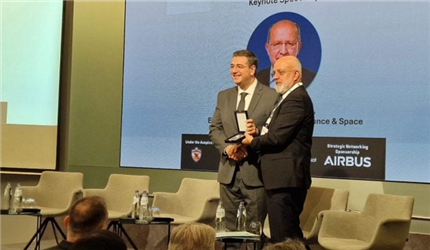
By Leta Kalamara
The new European policy and financing tools, and in particular the Multiannual Financial Framework /MFF 2028-2034 as well as the European Competitiveness Fund (ECF), are expected to be of decisive importance for the medium-term implementation of Europe's defense strategy, as highlighted in the 3rd Annual Greek Defence Industry Compass.
New policy and financing tools: cross-border cooperation and unity
According to the European Commission proposal, the MFF is estimated at approximately 2 trillion euros and the ECF at 522 billion euros and will support research, development and production in Europe, attracting private investment. The design includes a proposal for a multiplication of defense and space spending, amounting to a three-digit number of billion euros compared to the previous period 2021-2027.
All this, combined with the already existing tools that have been announced (ReArm Europe, SAFE, European Defence Fund, EDIP) as well as the compliance of the EU member states with NATO for defense spending at 5% of their GDP, leads to a huge amount of money for defense and the activation of the European defense industry, which includes Greek defense companies.
However, the priority is realistic planning, clear priorities and institutional coherence, so that the available resources can support the scaling up of production, the resilience of supply chains and cross-border industrial cooperation.
Speaking at the 3rd Annual Greek Defence Industry Compass, Andrius Kubilius, Commissioner for Defence and Space, sent a clear message about the need to strengthen European defence industrial capacity, increase production and secure supply chains, so that European resources are translated into real capabilities.
As he stated, "Europe now has the strategy, money and policy for defence, unlike a year ago. There is the White Paper, the Defence Readiness Roadmap 2030 and the individual proposals.
But what Europe needs now is unity in order to create common European defense programs that will lead to the shielding of common European preparedness and the European defense industry." According to Kubilius, member states are expected to spend trillions of euros on defense from their national budgets in the coming years due to their obligation to achieve the target of increasing defense spending to 5% of their GDP, based on NATO's direction.
In this context, the crucial role of infrastructure and military mobility as force multipliers for European security, linking civil and defense investment policies, was highlighted by Apostolos Tzitzikostas, Commissioner for Sustainable Transport and Tourism. Particular emphasis was also placed on the connection of civil and military infrastructure, the need to harmonize technical specifications and regulatory frameworks, as well as the role of large infrastructure projects as multipliers of security, resilience and industrial development.
Greek Defence Industry
Focusing on the Greek defence industry, the chairman of the Hellenic Manufacturers of Defense and Security Material Association, Anastasios Rozolis, stressed the immediate priority for the creation of an autonomous government structure for the Defence Industry. He pointed out that the Greek Defence Industry has entered a phase of maturation and substantial integration into the European Defence Technological and Industrial Base.
It considers the Defence Industry Transformation Roadmap as a constructive and necessary initiative, provided that it is implemented with realism, discipline and strategic coherence, so as to yield measurable results for the European and national defence industry. On his part, Brigadier General Emmanuel Giannoulakis, Deputy Director General of the General Directorate of Defense Armaments and Investments (GDAEE), underlined the importance of structured cooperation between the Armed Forces and industry, with an emphasis on solutions that are operationally mature, interoperable and realistic in terms of implementation time.
(Editor: liaoyifan )