

By Michalis Psilos
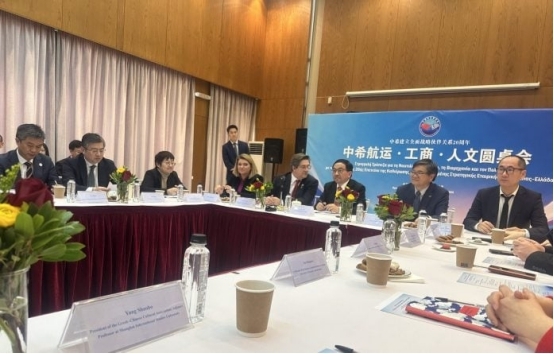
"Greece and China have embarked on a joint journey of cooperation for many years and today's roundtable discussion creates a platform for an open, friendly dialogue, aiming to strengthen mutual understanding between the two countries," said Chinese Ambassador to Greece Fang Qiu, speaking at a recent conference on Shipping, Trade, and Culture held at the Chinese embassy in Athens.
“Greece and China control 50% of global shipping,” underlined George Xiradakis, president of the Association of Banking & Financial Executives, coordinator of the first panel on the shipping cooperation between the two countries. “Without Greek and Chinese shipping, the supply chain does not function,” Xiradakis emphasized.
A decade of port development
This year marks 10 years since the full operation and management of the Piraeus Port Authority by Cosco Shipping, the CEO of the Piraeus Port Authority (PPA) noted.
“After more than a decade of development, the Port of Piraeus has become a modern hub connecting China, Greece, the Mediterranean region and wider Europe,” CEO Su Xudong said.
Annual container throughput has increased from 680,000 TEUs at the time of its acquisition to over 5.6 million, rising from 93rd to 25th globally. It is the fourth largest container port in Europe. The cruise terminal had 863 cruise ship calls, a 38% increase from 625 in 2016, serving 1.86 million passengers, up from 1.09 million in 2016 (+71%), making Piraeus the second largest cruise port. The ship repair terminal has recorded 1,389 days in berthing, an increase from 435 days in 2016 (+219.31%). The logistics sector handled 182,000 tons of cargo, a 99% increase from 2016.
State fees at 8.7 million euros
The concession fees paid by the port of Piraeus to the Greek government increased from approximately 2 million euros in 2016 to 8.7 million euros in 2024, while the dividend per share increased from 0.11 euros to 1.92 euros in 2025.
In June 2025, the company’s capitalization exceeded 1.24 billion euros, recording a 373% increase compared to the time of acquisition, marking a record since its listing on the stock exchange in 2003.
Mr. Su added that the port of Piraeus actively fulfills its corporate social responsibility, having created 4,300 direct jobs and 12,000 indirect jobs in Greece.
A world-class port
“Looking ahead, our goal is to develop the port of Piraeus into a world-class port,” noted Mr. Su. “To achieve this goal, we are fully committed to developing two main goals: digital intelligence and low-carbon green growth.”
“We aim to: First, strengthen our investment and financing platform; second, improve the quality and efficiency of the five port areas (cruise, coastal shipping, car park, container and ship repair); and third, build a world-class logistics park,” he explained.
Competitiveness & innovation
Antonis Venieris, the president of the International Maritime Association, stressed the need to strengthen the role of the port of Piraeus as a gateway for “clean” freight transport in Europe and the Mediterranean.
Referring to the port’s strategic location, he emphasized: “Greece’s geostrategic position is a given, but it is not a panacea. It alone does not ensure long-term success.” He added that what will determine the future of Greek ports is competitiveness, speed of adaptation and the ability to innovate.
In his turn, Captain Luo Shijun, Deputy General Manager of the Container Terminal (CPT SA), emphasized that the strategic location of Piraeus, being the first European port after the Suez Canal with a direct connection to the EU road and rail network, makes the port not only an ideal hub for destinations in the Mediterranean and the Black Sea, but also a viable partner for all interested distribution and Logistics service providers in Europe, the Middle East and Africa.
“The total handling capacity of the Piraeus Container Terminal increased from 1.5 to 6.2 million TEUs, more than doubling the annual volume of containers handled, and establishing the port among the top five ports in Europe and a leading one in the Mediterranean,” he stated.
Trade cooperation
The trade relations between Greece and China were the central topic of the second panel, moderated by Pella Karpathiotaki, a professor at the University of International Business and Economics in Beijing.
“The trade relations between the two countries are characterized by strategic importance, focusing on shipping, port infrastructure and investments, which are recording growth. There has been satisfactory development in recent years with key areas of exchange being manufacturing, mechanical equipment and high technology,” she noted.
The discussion was attended by Wu Bate, deputy director of China Energy Europe, which deals with renewable sources, Kevin Wang, executive director of Huawei for SE Europe, and Nikolas Takis, on behalf of the Sfakianakis Group, which imports Chinese BYD electric cars. It was even highlighted that 17 Chinese electric-vehicle brands are already being imported into the country.
Cultural Sector
Greece-China cooperation in the field of Culture was the topic of the third panel, with the participation of Professor Stelios Virvidakis, general secretary of the Center of Greek and Chinese Ancient Civilizations, Li Xinwei, director of the Chinese School of Classical Studies in Athens, head of the Confucius Institute at the University of Economics and Business, and Yang Shaobo from the Hellenic-Chinese Culture Association and professor at the Shanghai International Studies University.
The speakers emphasized that while Greek and Chinese civilizations are among the world’s oldest, their relationship remains vibrant, strengthened in recent years by the establishment of many schools of Ancient Greek in China.
At the same time, a Sinology Center has been established at the Ionian University and a Joint Digital Laboratory of China-Greece Cultural Heritage is operating.
More than 120 Greek students recently participated in the “Youth Envoy” scholarship program, gaining experience in Chinese society, while dozens of their Chinese colleagues are also attending seminars at Greek universities.
(Editor: fubo )