

By Antonis Tsimplakis
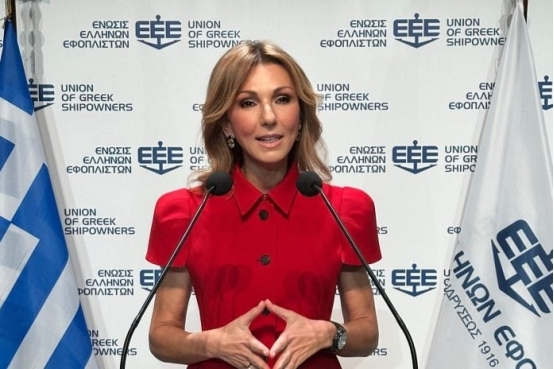
“Shipping must be preserved as the guardian of international trade and global prosperity,” said Melina Travlou, president of the Union of Greek Shipowners, in her speech at the annual general assembly.
In fact, Travlou stressed the importance of the Greek fleet: “As we saw, the Greek-owned fleet remained dominant both in Europe and in the international ranking. With the strategic management of our fleets, we are steadily maintaining our upward trajectory. And, at the same time, we are investing while remaining pioneers. As the leading force in Europe and as a global leader, we must view the new reality with a clear eye.”
Geopolitical competition
She also described the new reality in which the sustainability of shipping is more closely linked than ever to international politics. Competition is not only commercial. It is also geopolitical.
In this era where the competitiveness of our industry is being tested more than ever, its protection and strengthening at the national, European and international levels is of vital importance.
“We must always remember that our stable goal, stable policy and holistic planning can yield impressive results. In this disruptive environment, we are present where decisions are made, with a responsible, institutional and reliable voice,” she said.
LNG carriers: Greek shipowners lead the way
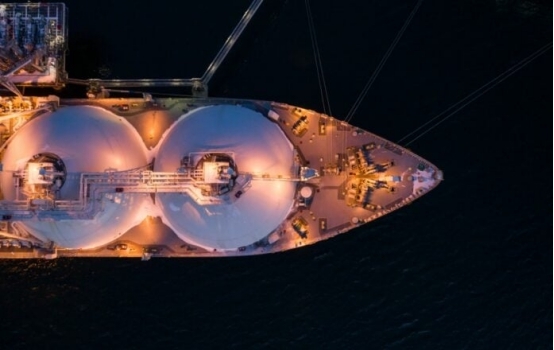
The global LNG carrier market is entering a new period of intense activity, with 2026 set to be a year of explosive growth in orders. Market estimates indicate that more than 100 new LNG carriers are expected to be ordered this year, a development that confirms that LNG remains a key pillar of the energy transition.
In this environment, Greek shipowners are not only actively participating, but also maintaining a leading role, further strengthening their position in the strategically important gas carrier sector.
The latest development is the move by TEN, owned by Dr. Nikos Tsakos, which—according to information—is in advanced discussions for the construction of 2+2 LNG carriers with a capacity of 174,000 cubic meters at the HD Hyundai shipyards in South Korea. As market sources emphasized, the ships are expected to be delivered in 2028, while this activity is part of the group’s diversification strategy and its effort to strengthen its presence in the energy sector.
At the same time, TMS Cardiff Gas, owned by George Economou, expanded its order book with four new LNG carriers with a capacity of 174,000 cubic meters, with an option for two more ships. The new buildings will be constructed at China’s Hudong-Zhonghua shipyards and will be equipped with GTT’s NO96 Super+ system, designed to reduce carbon emissions by more than 10 tons per day. The choice of Hudong-Zhonghua also highlights China’s gradual rise in the demanding LNG carrier sector, which until recently was almost exclusively dominated by South Korean shipyards.
Alpha Gas, part of the Anna Angelicoussis group, continues its strategy of strengthening its presence in the LNG market, ordering two ultra-modern tankers in South Korea. Their delivery is scheduled for 2029 and is part of a broader fleet renewal and development plan. The company already has a strong presence in the sector, with four LNG carriers under construction, expected to be delivered in 2026 and 2027.
These projects add to an already strong Greek footprint in the sector. According to the latest data from Xclusiv Shipbrokers, by the end of January, Greek shipowners controlled 58 LNG carriers on order, corresponding to approximately 18% of the global orderbook of 314 ships. The majority of orders are for vessels with a capacity of 141,000 to 200,000 cubic meters, which form the backbone of the modern LNG trade.
(Editor: fubo )