


By Natassa Stasinou
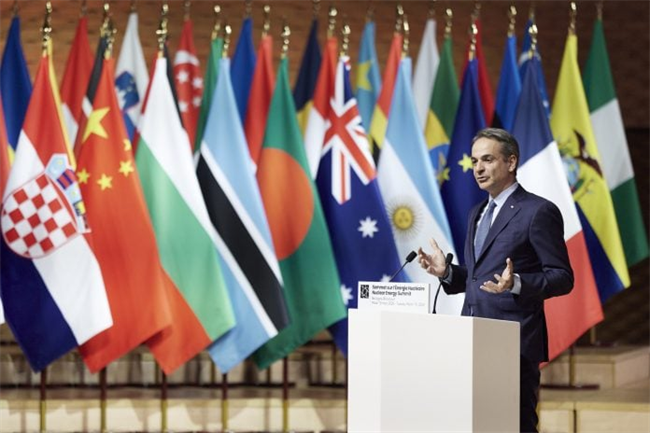
The time has come for Greece to explore if nuclear modular reactors can play a role in its energy system, Prime Minister Kyriakos Mitsotakis said in a conference on nuclear power held in Paris, adding that a top-level ministerial committee will be set up to make recommendations on the issue.
Europe cannot achieve the things that it wants – strategic autonomy, economic competitiveness and phasing out of carbon – without nuclear power and "unfortunately, Europe has lately turned away from nuclear energy."
In two decades nuclear output in Europe has declined, Mitsotakis said, while the combined output of all the solar panels installed in the EU over the past 20 years did not make up for this loss of nuclear power. The Greek premier described this as a "own goal" but added that nuclear energy is now "clearly having a comeback."
Mitsotakis pointed out that this was a common sense position, given the radical technological developments and huge innovation in nuclear technology, as well as the constantly rising need for electricity.
"Regardless of how much we expand renewable energy sources, we will need a long-term, predictable baseload power," he added, noting that no other technology can compete with what nuclear power can offer, even though public opinion remains divided.
The Greek premier also said that Greece is particularly interested in nuclear energy in shipping, noting that the technology has been used in the military for decades.
"We have no reliable solution for decarbonizing shipping," he stated. "Nuclear energy must be part of that discussion, and Greece wants to be at the forefront."
"Greece is ready to write a new chapter. It is a friend of nuclear energy, whether nuclear power ends up playing a role in Greece or not," he said.
"In times of major upheaval, all options should be on the table, and our task is for nuclear energy to be part of the solution again," he added.
Fitch: Greece faces energy shock risks from Middle East war, but Eurozone is a shield
The Greek economy is showing strong fiscal performance, resilient growth and significant progress in the labour market, yet it continues to face structural challenges and new external risks. In this environment, the war in the Middle East is creating another energy shock for the global economy, with potential implications for inflation and businesses, according to remarks made during a Fitch Ratings webinar on Greece attended by Naftemporiki.gr.
Responding to a question from Naftemporiki about the impact of the Middle East conflict, Greg Kiss stressed that the war represents another shock for the global economy, primarily through energy markets. He estimated, however, that the conflict could last less than a month and highlighted the "shield" Greece enjoys.
"The war in the Middle East is a new shock for the global economy. We have already seen significant damage to energy facilities across the Gulf," he said. According to him, the main impact will come from the energy supply side, which could lead to higher prices and renewed inflationary pressures worldwide. "The shock to energy supply will lead to higher inflation and intensify pressure on the global economy," he noted.
Despite the concerns, Fitch believes the impact could remain limited if the crisis does not drag on.
"We believe the conflict could last less than a month," Greg Kiss said, adding that under such a scenario Greece's growth rate could remain close to 2%.
Regarding Greece, Greg Kiss stressed that the country's participation in the Eurozone is an important factor of stability during periods of international turbulence.
"It is important to say that Greece benefits from being a member of the Eurozone. This is a very important shield for the country," he said.
At the same time, he noted that Greece continues to enjoy particularly favourable financing conditions, which makes it less vulnerable to the impact of tighter monetary policy compared with other economies.
However, there is also a clear point of vulnerability: the country's dependence on energy imports.
"The main vulnerability of Greece relates to its reliance on energy imports," he said, stressing that a prolonged energy shock could affect the economy mainly through higher prices.
(Editor: liaoyifan )