


By Antonis Tsimplakis
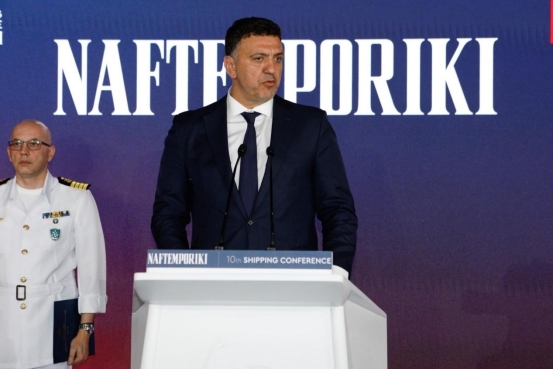
Minister of Maritime Affairs and Insular Policy Vasilis Kikilias called on Europe to reassess its strategy towards shipping, energy, and industrial self-sufficiency during his address at Naftemporiki’s 10th Shipping Conference.
The minister warned that anyone who believes developments in shipping do not affect the average Greek and European households “is making a major and fatal mistake,” stressing that geopolitical crises have a direct impact on inflation, energy prices, fuel supply adequacy, and the real economy as a whole.
Referring to developments in the Persian Gulf and the conflict in Ukraine, he noted that the international community is entering a prolonged period of instability.
“Experts believed the conflict in Ukraine would last five days, and it has already lasted four and a half years. I fear we still have a long way to go,” he stated. As he emphasized, governments, societies, and industry must prepare for the consequences ahead, reminding the audience that 90% of global trade is conducted by sea.
“How governments manage this crisis will determine their political survival,” he said, noting that political upheavals and government changes are already emerging around the world.
Strong and interventionist presence in international forums
Kikilias underlined that Greece must maintain a stronger and more interventionist presence in European forums and at the IMO, leveraging the strength of Greek shipping, which he described as “a miracle built by three to four generations of Greeks.”
Protecting the country’s interests
“We dared and implemented a more assertive policy that protects the country’s interests,” he stated, adding that Greek interests largely coincide with European interests.
At the same time, Kikilias warned against policies that, as he said, serve individual national interests at the expense of overall European competitiveness, noting that Greece, Cyprus, Malta, Italy, and, on several issues, Spain, are now shaping common positions.
LNG cannot be banned
The minister also criticized the discussion about the complete ban on LNG as a transitional fuel from 2027, raising the question of whether Europe can withstand another rise in energy prices and a new wave of inflation. “We must very seriously reconsider what our revenues are and what we need to protect as the apple of our eye,” he stated, placing emphasis on energy and maritime infrastructure, shipyards, FSRUs, and future drilling projects.
A vision for the younger generation
Concluding his remarks, Kikilias placed particular emphasis on the younger generation and employment prospects in shipping and maritime professions. As he noted, Greece used to direct young people toward public-sector careers; however, the maritime industry can now offer well-paid jobs, high-level education, and strong long-term career prospects. “This is a vision for the future. This is a source of hope. This is growth,” he concluded.
China’s cooperation with Greece for the prosperity of the shipping
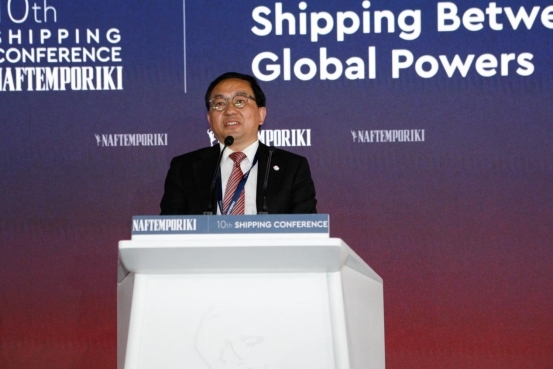
Fang Qiu, Ambassador of the People’s Republic of China, highlighted the cooperation between Greece and China in the maritime sector during his address at the conference.
As he emphasized, China is ready to cooperate with Greece for the prosperity of the shipping industry. “It is a great honour to be present at this important event,” he noted, adding that the sea has always connected the two countries despite the great distance between them.
The Chinese Ambassador stated that Greece has a long maritime tradition and pointed out that today the two countries continue to exert influence on global shipping.
He also cited the Port of Piraeus as an example of this cooperation. He also stressed that the world is undergoing rapid change and that the shipping industry is facing complex challenges, shaped by geopolitical tensions and the need for a green transition.
(Editor: fubo )