


By Antonis Tsimplakis
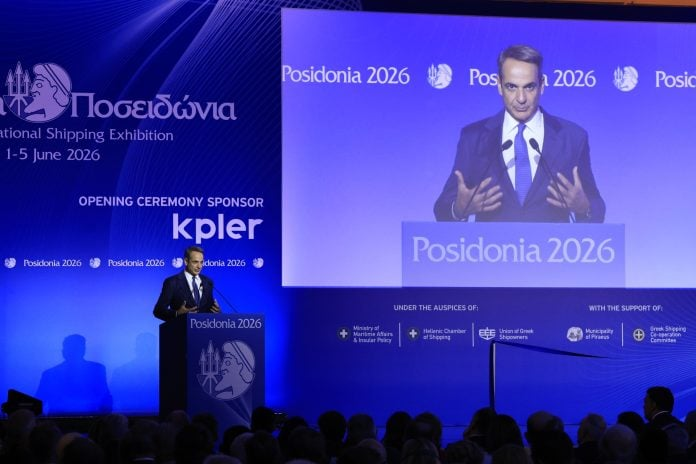
The Greek-owned shipping industry is a vital strategic asset for both Greece and Europe and it must be safeguarded, particularly at a time when its geopolitical importance is more evident than ever, Prime Minister Kyriakos Mitsotakis said in his address at Posidonia 2026.
Mitsotakis described shipping as "a source of strategic power linked to the resilience and strategic autonomy of both Greece and Europe, positioning the country as a globally significant commercial player."
The Prime Minister characterized the green transition as "an investment in the future."
"I believe in the green transition, and it is no coincidence that Greece has risen to third place globally in this field," he said. However, he stressed that while the transition is necessary, "it must not come at the expense of shipping. Any additional costs are ultimately passed on to end users." Mitsotakis noted that any disruption to freedom of navigation translates into a global energy shock.
"You understand the significant geopolitical and geoeconomic influence that Greece derives from the fact that 25% of the global fleet and more than 80% of Europe's oil and LNG transportation fleet are owned by Greek shipowners. These vessels transport critical commodities and raw materials. This constitutes a strategic advantage for our country, linked to the resilience and strategic autonomy of both Greece and Europe, making Greece an important international player with a pivotal global role."
Maritime security a central theme
He recalled that Greece had already made maritime security a central theme of its presidency of the United Nations Security Council several months ago.
"The Greek state decided to participate actively in Operation Aspides in the Red Sea in order to safeguard freedom of navigation in practical terms," he said, referring also to the deployment of the frigate Psara in the region.
"Greece is actively pursuing the restoration of the previous status quo in the Strait of Hormuz so that no tolls or transit fees are imposed. The strait must remain a corridor of free navigation, as it has been and should once again become. Greece will continue to raise this issue in every diplomatic engagement and at the United Nations Security Council, as we will again hold the presidency in October," he added.
Mitsotakis also highlighted the green transition, stressing that the Greek-owned fleet is already leading this transformation.
"Greece has evolved from a net importer of electricity into a country exporting electricity to the Balkans. At the same time, I am a realist. This transition is necessary, but under no circumstances can it undermine the competitiveness of shipping. We must focus on achievable objectives. Global shipping accounts for less than 2% of carbon emissions while transporting 90% of world trade. Until this transition fully matures, we must chart a course that is economically rational and does not impose additional burdens on global shipping. If Europe wishes to remain a prosperous economy, it must avoid ideological rigidity and adopt a pragmatic approach," he explained.
He expressed confidence that the concerns raised by Greece and other major maritime nations would be taken into consideration during negotiations on the final regulatory framework.
Revival of Greece's shipbuilding industry
"At the national level, this government can take pride in the revival of Greece's shipbuilding industry. Shipyards are productive hubs by the sea, creating jobs and offering attractive remuneration. We are equally proud of the dynamism of our ports. We must pay attention not only to the major ports but also to the smallest island ports. We are proud of our coastal shipping sector and particularly proud of Piraeus."
He stressed that this message must resonate throughout society and highlighted the need to make maritime careers more attractive to younger generations.
"This is a challenge we must address together. Artificial Intelligence is already being deployed across the industry, but the human factor at sea will always remain decisive. Greece has also succeeded in attracting the management of third-party fleets. We possess all the necessary prerequisites to make the Greek flag an increasingly attractive choice as well."
The Prime Minister concluded by expressing confidence in the future of Greek shipping.
"I am optimistic that Greek men and women will continue to dominate the world's oceans. The vision, pragmatism and boldness that brought Greek shipping to the top of the global industry will remain its greatest strengths. The Greek state will continue to be a steadfast ally, recognizing shipping as a unique global competitive advantage for our country. Together, we can achieve even more and we can progress further. I wish every success to Posidonia and fair seas to all."
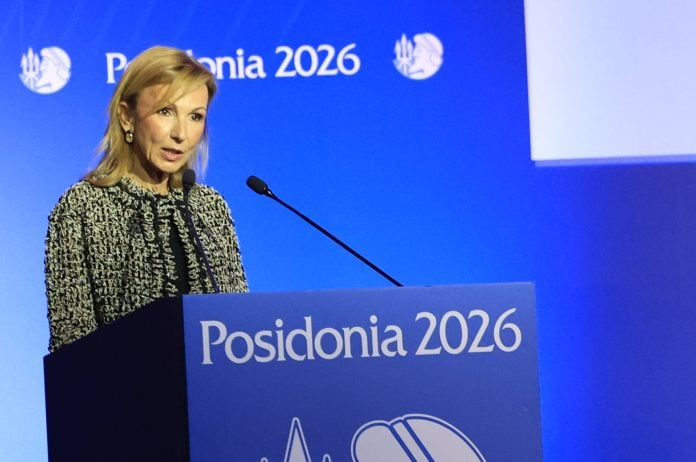
Travlou at Posidonia: There is no resilient economy without strong shipping
"There can be no global prosperity without freedom of navigation," stated Melina Travlou, President of the Union of Greek Shipowners, during her address at Posidonia 2026, where she underscored the global responsibility to protect shipping.
"Two years ago, from this very stage, we presented an international study on what the world would look like without shipping. The findings were clear: within 90 days, the planet would come to a standstill. And today, the reality we are experiencing confirms this," she said, referring to recent developments in the Strait of Hormuz.
"When shipping is obstructed, it is not merely an industry that is disrupted. The very functioning of the world is disrupted," she emphasized, stressing that shipping must never be instrumentalised or targeted under any circumstances. "Freedom of navigation is a condition of international stability and progress."
She added that maritime routes are not merely trade corridors but "the arteries of the global economy," noting that seafarers must never be exposed to heightened risks, let alone threats to their lives. She expressed hope that peace and respect for international law would prevail, ensuring that seas remain open, safe, and free for the benefit of all nations. "Shipping is the invisible guarantor of our daily life, becoming visible only when the world is under strain," she noted.
"The future of land is decided at sea"
The President of the Union of Greek Shipowners stressed that "history teaches us that the future of land is decided at sea," adding that both the present and future of humanity continue to be shaped in the world's oceans. As such, she underlined that the protection of shipping must lie at the core of state strategy and decision-making centres.
Challenges and green transition
In this context, she welcomed the European Commission's decision to finally prioritise the global competitiveness of European shipping, a competitiveness closely linked to the sector's major challenge: decarbonisation.
"The Greek shipping industry is actively acknowledging the need for transition to cleaner energy sources, investing billions in new vessels equipped with advanced technologies and alternative, and in some cases experimental, fuels. However, it must be taken into account that shipping has the lowest environmental footprint, accounting for only 1.6% of global greenhouse gas emissions, while at the same time being one of the most complex sectors to fully decarbonise," she noted.
"Without realism, there is no sustainable green transition"
She also stressed that the decarbonisation of shipping depends entirely on external factors: "Safe and available fuels, appropriate technologies, and adequate infrastructure are all outside the direct control of the industry."
According to Travlou, a successful green transition requires technological feasibility, economic viability, global coordination, and a level playing field. Otherwise, she warned, it would result in higher costs across the supply chain without corresponding environmental benefits.
"The key challenge ahead is clear: to align the international regulatory process with maritime expertise and the operational realities of the sector. Let us be realistic: without freedom of navigation there is no global prosperity; without safe sea lanes there is no secure global trade; without strong shipping there is no resilient economy; and without realism there is no sustainable green transition," she said.
She concluded that the protection of shipping is not merely a functional requirement of global trade, but a shared global responsibility requiring transparency and honesty.
Closing her speech, Travlou thanked the Prime Minister for recognising Greek shipping as a national asset—both in its economic and humanitarian dimension—as well as a global geopolitical advantage for Greece, honouring the words of Pericles: "For the power of the sea is great."
(Editor: liaoyifan )