


By Meng Fanrong
NINGBO, Jun 24 (China Economic Net) - As Pakistan grapples with a poverty rate affecting approximately a quarter of its population, a Pakistani scholar based in China said Beijing's success in lifting more than 800 million people out of extreme poverty offers a practical and scalable roadmap for his home country, provided that the model is adapted to local conditions.
Dr. Muhammad Khalil Khan, an associate professor at NingboTech University and director of its "Belt and Road" International Communication Research Center, made the remarks in a recent interview with China Economic Net. Having lived in China for more than a decade, Dr. Khan has conducted extensive field research across Zhejiang province and its surrounding regions, witnessing what he calls "an unprecedented case in the developing world".
"The speed and scale of China's poverty reduction have left me deeply impressed," Dr. Khan said. "What fascinates me most is the model's ability to combine state-led initiatives with market-oriented reforms, particularly in rural areas. The essence lies in connecting remote regions through physical and digital infrastructure while empowering individuals with skills and entrepreneurial capabilities."
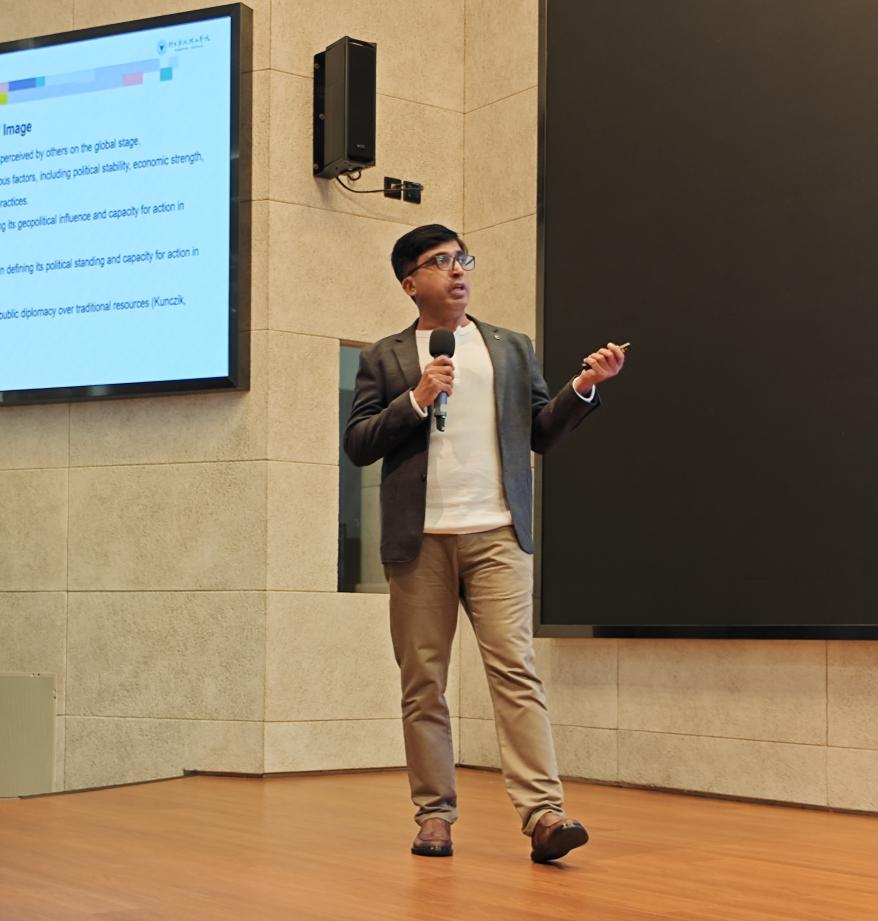
Dr. Muhammad Khalil Khan gives a presentation. [Photo provided to CEN]
From E-Commerce to Homestays: Replicable Models
Dr. Khan's research has identified several grassroots initiatives that he believes Pakistan could replicate. In villages near Zhoushan, he observed how local specialty fruits were branded and sold through e-commerce platforms like Taobao and Pinduoduo, directly linking farmers with urban consumers and solving the chronic problem of perishable goods going unsold. "Farmers could participate in economic activity through digital platforms without leaving their homes, significantly boosting their incomes," he noted.
In Yuyao, he documented the "one household, one factory" model, where families established small workshops in their homes to produce parts for larger enterprises or sell directly to consumers. This approach enabled entrepreneurship without migrating to urban areas, preserving social structures while generating livelihoods.
In mountainous Lishui, government-backed homestay facilities allowed villagers to attract urban tourists for weekend getaways, transforming natural landscapes into sustainable economic opportunities.
Structural Challenges and Targeted Interventions
Dr. Khan argues that Pakistan's specific challenges, namely a young population with high unemployment, a rural adult literacy rate of roughly 50 percent, and low female labor force participation, call for targeted solutions drawing on China's experience.
"China's achievement in lifting hundreds of millions of people out of poverty serves as a global example of people-centered development," Dr. Khan said. "The integration of industrial development, human capital building, and grassroots governance has been central to China's poverty reduction efforts."
He stressed the need for Pakistan to focus on industrialization, vocational education, gender equality, and infrastructure development, while also citing several "small yet beautiful" projects already implemented, including small hydropower stations in the northern remote areas to ease power shortages and aid irrigation; community-led solar projects to supply electricity to homes and health centers while creating local jobs; and community-based water resource management to boost agricultural sustainability.
A New Phase for CPEC
Dr. Khan highlighted that China's poverty alleviation experience offers a "systematic cooperation blueprint" for Pakistan, particularly as the China-Pakistan Economic Corridor (CPEC) transitions into its second phase. This new phase aligns with Pakistan's 5Es framework, namely Exports, E-Pakistan, Environment, Energy and Infrastructure, and Equity and Empowerment, and envisions transforming Pakistan into a US$1 trillion economy by 2035.
Pakistani Minister for Planning, Development & Special Initiatives Prof. Ahsan Iqbal has already indicated that Pakistan will draw on China's poverty alleviation model in underdeveloped districts, signaling a growing consensus on the value of bilateral cooperation in this domain.
"China's success was not accidental," Dr. Khan said. "It was the result of sustained political commitment, institutional innovation, and a willingness to experiment with local solutions on a national scale. For developing countries seeking to replicate this success, the key is not to copy every policy, but to understand the underlying principles of governance, investment in human capital, and infrastructure-led connectivity that made it possible."
(Editor: liaoyifan )