


by Liu Qiyu
As Tropical Cyclone Maila approached Papua New Guinea in April, meteorologists were not relying on conventional forecasting tools alone.
On China's cloud-based early warning platform, images from Fengyun meteorological satellites tracked the evolution of the storm, while forecasts from the China Meteorological Administration's CMA-GFS numerical weather prediction system and its AI-powered Fengqing model provided projections of the cyclone's path, winds and rainfall.
Ruben Wamuni, a meteorologist at the Papua New Guinea National Weather Service, said the AI model accurately captured the strengthening and subsequent weakening of winds over Port Moresby, while also identifying the rainfall process and the intensity of peak precipitation. He added that visible and infrared satellite imagery proved particularly effective in tracking the cyclone's evolution.
The Papua New Guinea National Weather Service also received a preparedness report from Chinese meteorological authorities. By analyzing Maila's projected track, the timing of its expected impacts on Port Moresby and potential risks, the report provided recommendations to support disaster preparedness and emergency response.
"It greatly optimized the work of forecasters in compiling information, assessing impacts and preparing reports, providing valuable support for emergency decision-making," Wamuni said.
China hopes such scenes will soon become increasingly common around the world.
At the just-concluded 2026 World Artificial Intelligence Conference (WAIC) held in Shanghai, China announced that it will help 30 countries utilize the AI-powered MAZU meteorological early warning system over the next five years as part of a broader package of initiatives to support global AI development.
While global discussions around artificial intelligence are often dominated by frontier models and computing power, Beijing is increasingly promoting AI as a tool for tackling one of climate change's most urgent challenges, that is, helping vulnerable communities prepare for extreme weather before disaster strikes.
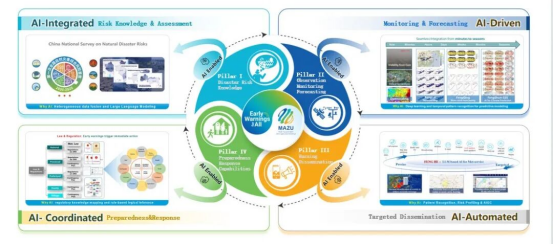
Unlike a standalone AI weather model, MAZU is China's comprehensive solution supporting the United Nations' Early Warnings for All initiative. Developed by the China Meteorological Administration (CMA), it has evolved into a shared, customizable and sustainable one-stop solution covering multiple meteorological hazards.
The platform integrates cloud-based services, Fengyun meteorological satellite observations, AI-powered forecasting, monitoring, early warning and impact-based forecasting into a single operational system. Rather than simply predicting rainfall or wind speed, it is designed to help forecasters better understand how hazardous weather may affect transportation, agriculture, energy systems, aviation and other sectors.
The upgraded public-cloud version now offers more than 200 products across 30 categories, with artificial intelligence embedded throughout the platform. According to the CMA, its services have expanded from traditional weather forecasting to impact-based forecasting, allowing meteorological agencies to better anticipate not only what weather will occur, but also what consequences it may bring.
The name itself reflects the platform's philosophy.
Named after Mazu, the sea guardian revered along China's southeastern coast for protecting fishermen and sailors from storms, the English acronym stands for Multi-hazard, Alert, Zero-gap and Universal. The concept bridges traditional wisdom with modern technology while reflecting the core purpose of early warning, namely, protecting lives before disasters happen.
The initiative also supports the United Nations' ambition of ensuring everyone on Earth is protected by early warning systems. And MAZU is the first national-level solution developed in direct response to that global initiative.
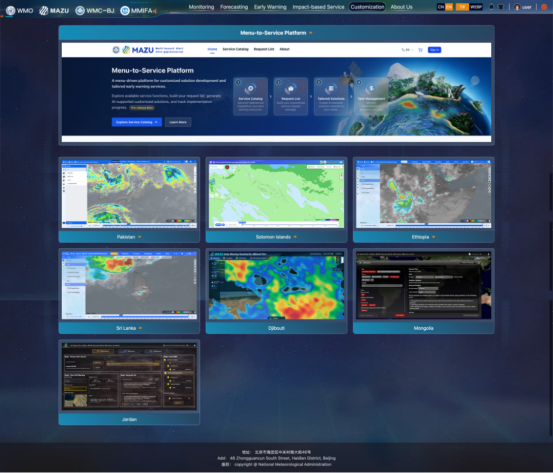
Today, MAZU's cloud-based applications support users in more than 40 countries, while customized versions have been deployed in Pakistan, Ethiopia, the Solomon Islands, Jordan, Sri Lanka, Mongolia and Djibouti.
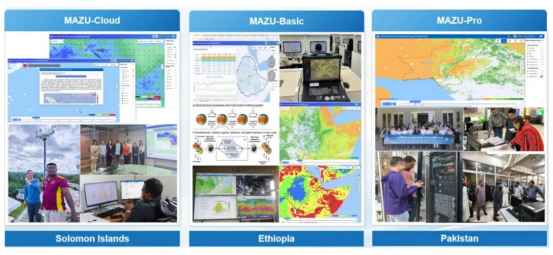
Rather than offering a one-size-fits-all platform, MAZU is designed to adapt to local needs.
In Pakistan, where glacial lake outburst floods, monsoon rainfall and severe storms pose recurring risks, Chinese and Pakistani meteorologists jointly developed specialized forecasting tools while integrating Pakistan's own radar and satellite observations into the platform.
In Jordan, the system has been adapted to support Arabic-language warning dissemination.
In Djibouti, it provides dedicated weather warning services for ports and urban management.
In Mongolia, forecasters use its integrated tools for risk assessment, monitoring, forecasting and emergency response to strengthen sandstorm prediction and urban disaster preparedness.
Meanwhile, Ethiopia has expanded the platform to support agriculture, river basin management, aviation and marine services.
Behind the platform is a rapidly expanding global meteorological service network.
The National Meteorological Information Center has established permanent overseas cloud nodes in Singapore and Cairo to improve system accessibility for international users, while Fengyun meteorological satellite data now serve users in more than 130 countries and regions. According to the CMA, artificial intelligence has also been deeply integrated into specialized forecasting tools, including a sand and dust forecasting model capable of running significantly faster than traditional numerical forecasting systems.
For China, the next challenge is no longer whether AI can generate weather forecasts, but whether those forecasts are reliable enough to support operational decision-making during increasingly frequent extreme weather events.
"Artificial intelligence has become an important engine for improving forecasts and early warnings for hazardous weather," Pan Jinjun, chief engineer of the CMA, told media. He noted that AI models have already demonstrated strong capabilities in forecasting typhoons and other hazardous weather, but challenges remain, including the limited availability of extreme weather samples and the need to improve model reliability before AI systems can be fully trusted in operational services.
China is pairing technology with long-term capacity building.
According to the CMA, nearly 1,000 meteorological professionals from more than 100 developing countries and regions have participated in China's early warning training programs in recent years. In June, the agency also launched the MAZU Scholarship to support meteorological professionals from Belt and Road partner countries working on early warning systems and the local application of MAZU.
The platform itself is also becoming more demand-driven. A newly launched "menu-based" service platform allows meteorological agencies, disaster management authorities and international organizations to select observation equipment, satellite products, AI forecasting models and other services according to their operational needs, with more than 100 international cooperation projects already available.
The announcement that MAZU will expand to 30 countries over the next five years marks the next stage of that effort.
As climate change increases the frequency and intensity of extreme weather, countries are searching not only for better forecasts, but also for faster warnings and stronger resilience.
The global race in artificial intelligence may continue to be defined by increasingly powerful foundation models. But for communities facing floods, storms and droughts, another frontier is quietly emerging - using AI to ensure that the next warning arrives before the next disaster does.
(Editor: liaoyifan )