

By Zafar Hussain
Customs data show Pakistan’s imports of Chinese plug-in hybrid and electric vehicles surging more than tenfold in the first half of 2026, as Pakistani consumers and policymakers embrace a fast-electrifying auto market.
BEIJING, Aug. 4 (China Economic Net) -- Pakistan's roads are quietly being rewired for the electric era, and the customs data behind that shift tell an unambiguous story: imports of Chinese plug-in hybrid vehicles (PHEVs) surged by nearly elevenfold in unit terms during the first half of 2026, marking the fastest-growing segment in the bilateral trade relationship between the two countries.
According to trade statistics compiled by the General Administration of Customs of China (GACC), Pakistan imported plug-in hybrid station wagons in the 1.0-1.5 litre class (commodity code 87036023) worth $191 million in January-June 2026, up from just $16.3 million a year earlier, a 1,073% jump in value driven almost entirely by a genuine surge in unit volume crossed 12,513, which rose 857%. Plug-in hybrid saloon cars in the same engine class followed a similar trajectory, climbing from $9.2 million to $90.3 million, with unit sales up nearly tenfold.
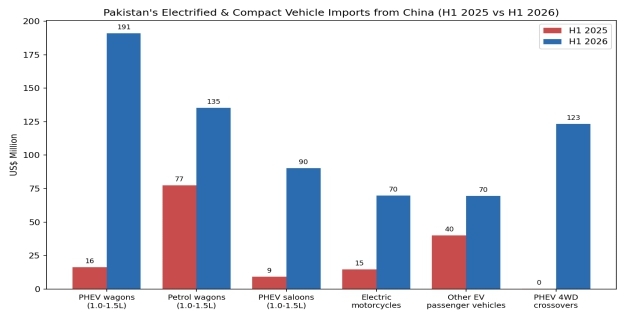
Figure 1: Pakistan's electrified and compact vehicle imports from China, H1 2025 vs H1 2026 (US$ million). Source: GACC.
Owais Mir, Founder and Chief Executive of Dynamic Engineering & Automation (DEA) Group told China Economic Net that plug-in hybrid 4WD crossovers, a category that was almost entirely absent from the Pakistani market a year ago, brought in a combined $123 million in the first half of 2026 alone.
The electrification wave extends beyond passenger cars. Imports of Chinese electric motorcycles nearly quintupled in value, from $14.7 million to $69.9 million, pointing to fast-growing adoption of electric two-wheelers, a segment with outsized relevance for Pakistan's urban commuters, where motorcycles remain the dominant mode of daily transport for millions of households.
“Every major new-energy vehicle line plug-in hybrid wagon, saloons and 4WD crossovers grew at triple-to-quadruple-digit rates in the first half of 2026”, Owais stated.
Industry experts believe the pace of growth reflects both pent-up consumer demand after several difficult years for Pakistan's auto-financing environment and the increasing affordability of Chinese-made hybrid and electric models compared with legacy internal-combustion alternatives.
Omar Malik, Chairman & CEO of Kingsbridge, told China Economic Net that at the heart of Pakistan's historic automotive transformation lies the clean energy target aiming to convert 30% of the nation's vehicles to electric power by 2030. Underscoring this strategic synergy, Omar Malik, observed that "demand is driven by policy," emphasizing that as Pakistan pursues its 30% conversion goal, "China’s supply chain supports a competitive price, which supports Pakistan's industry."
“Rising fuel costs make electric mobility the inevitable future of affordable transportation, while smooth, clutch-free electric bikes offer Pakistani women a safer, quieter, and more independent way to commute. This slashes daily travel expenses for families while directly advancing the UN’s Sustainable Development Goals for clean energy, climate action, and gender equality”, Malik added.
(Editor: fubo )