

By Meng Fanrong
ISLAMABAD, Aug. 14 (China Economic Net)- A four-day Chinese language and culture experience course kicked off on Monday, bringing together approximately 50 Chinese and Pakistani students, guests and staff in a hands-on celebration of shared heritage under the banner “The Language of the Eastern Silk Road – Bridging China and Pakistan, Celebrating Shared Cultural Splendor.”
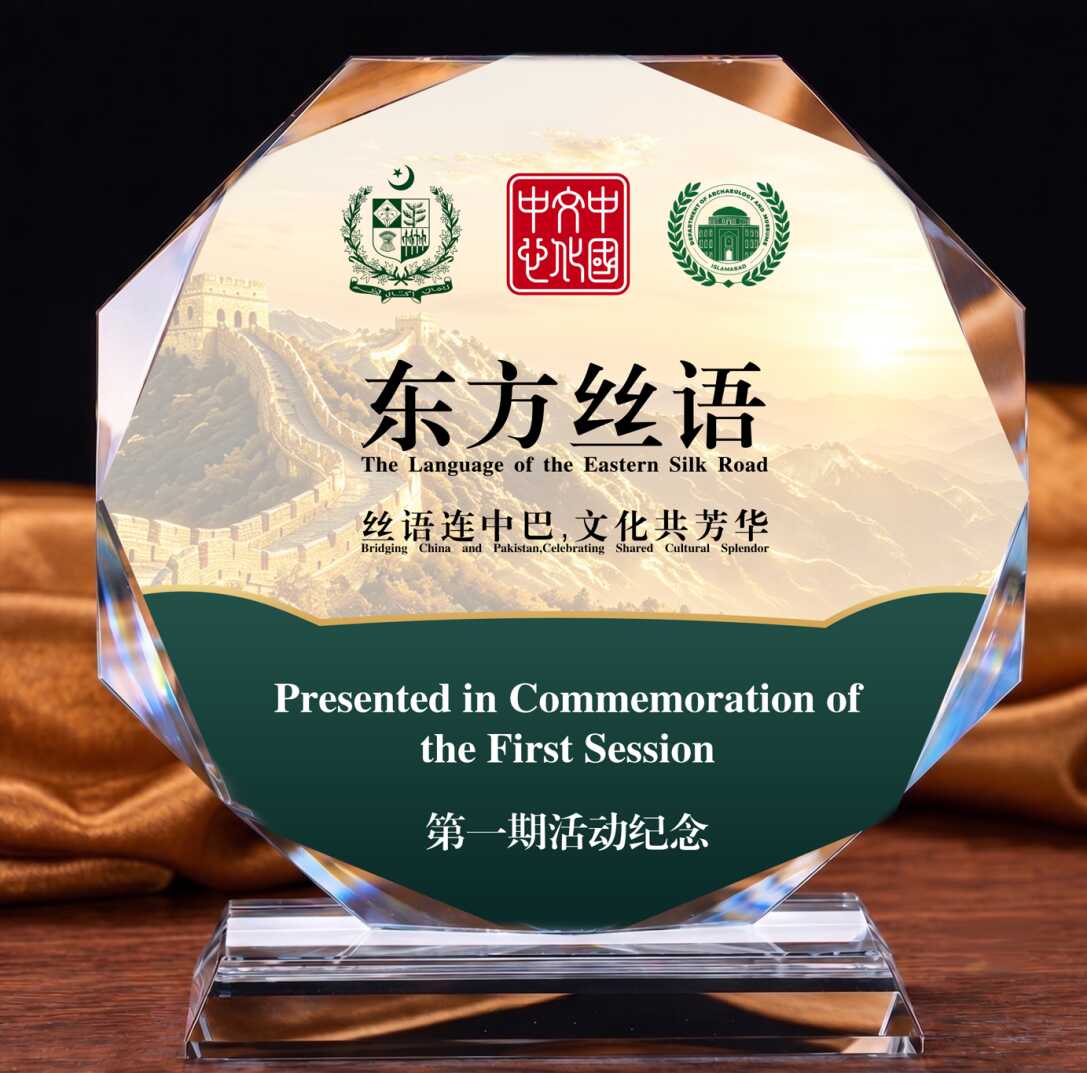
The commemorative piece marks the first session of the “Language of the Eastern Silk Road” Chinese language and culture experience course, photo provided to CEN
Held at the Department of Archaeology and Museums (DoAM) through August 13, the program is organized by the China Cultural Center in Islamabad, DoAM, and the Pakistan-China Cultural and Economic Promotion Association.
The curriculum packs six sessions each running 60 to 90 minutes, covering contents from Pinyin basics and Chinese character strokes to calligraphy, traditional festivals and a dumpling-making session that promises to be as tasty as it is educational.
“Language and cultural exchange are vital to strengthening people-to-people contacts and further deepening the enduring friendship between our two countries,” said Pakistani Federal Minister for National Heritage and Culture Aurangzeb Khan Khichi at the opening ceremony. He highlighted that while political, economic and infrastructural cooperation under the China-Pakistan Economic Corridor remains robust, “the true foundation of the bilateral relationship lies in people-to-people contacts and cultural exchange.”
Cultural Counselor of the Chinese Embassy in Pakistan, Chen Peng, drew attention to the deep historical threads connecting the two civilizations, with the Silk Road as a living bridge. He singled out the cultural resonance between Gandhara and Dunhuang, noting that bilateral cooperation in archaeology and heritage protection has delivered encouraging results. “Through mutual learning and the protection of cultural heritage, we can write a new chapter of shared understanding,” he said.
For Bai Jie, chairperson of the Pakistan-China Cultural and Economic Promotion Association, the real magic happens when participants move beyond screens and textbooks. “When the first Chinese character is written on rice paper, and when dumplings made by their own hands are served steaming hot, those distant stories suddenly acquire warmth, flavor and tangible form,” she told China Economic Net.
The course comes at a time of surging demand for Chinese language learning in Pakistan and reflects a shared commitment to cultural and educational investment, a cornerstone of the all‑weather strategic partnership that has now flourished for 75 years. With a mix of lively drills, artistic expression and culinary fun, the course offers participants a taste of China that goes far beyond words.
(Editor: wangsu )