


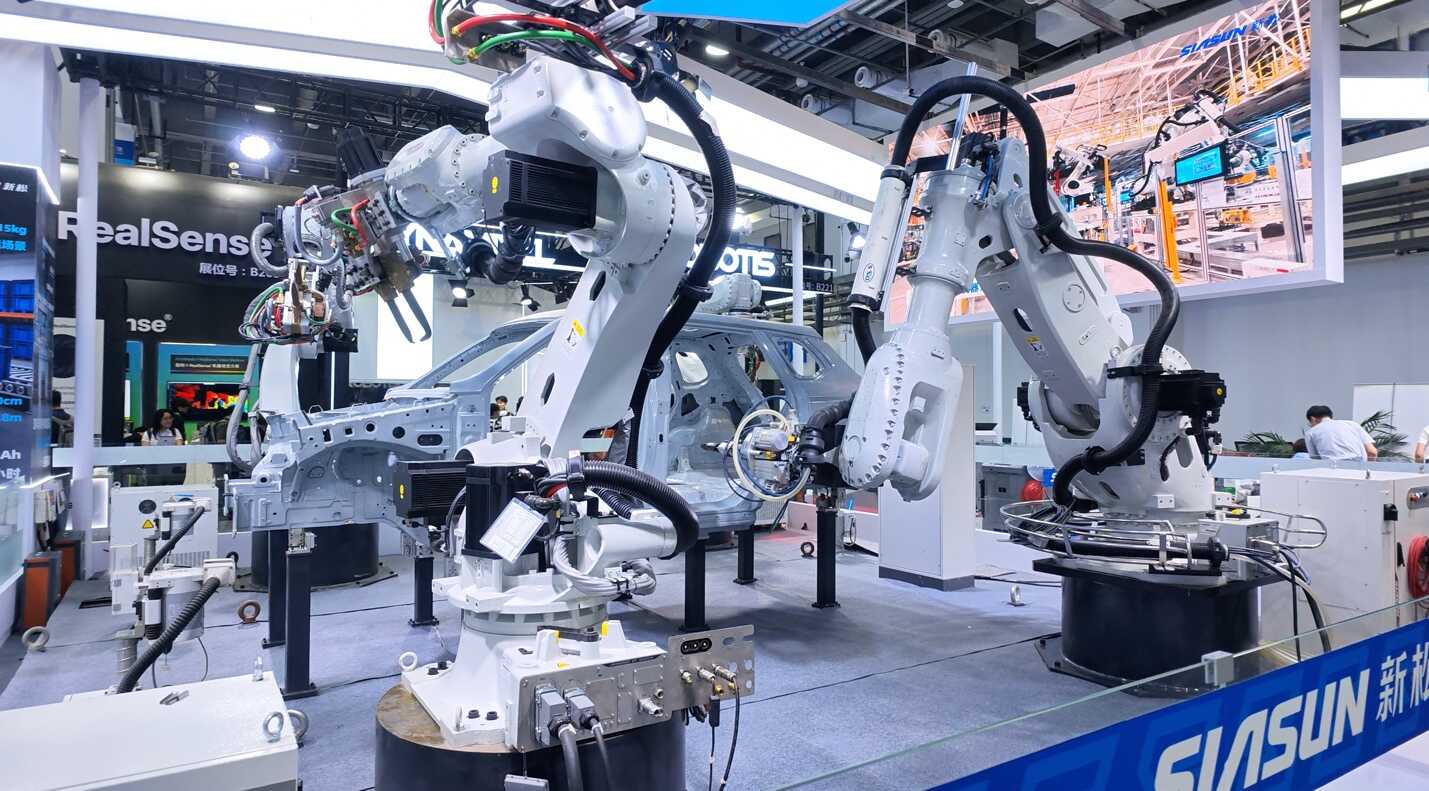
Industrial robotic arms demonstrate coordinated vehicle assembly at the 2026 World Robot Conference in Beijing. [China Economic Net/ Xiong Weisheng]
BEIJING, Aug 24 (China Economic Net) - A global robotics programme launched in Beijing aims to provide free trials and customisation for 1,000 real-world application scenarios a year. The programme comes as industry groups in developing economies seek cooperation with China that pairs equipment with skills training and support for local deployment.
The Global Robot Application Exploration Program was launched at the World Robot Conference on 20 August. It was proposed by the World Robot Cooperation Organization and the Chinese Institute of Electronics
China exported 6.29 billion yuan of industrial robots in the first half of 2026, up 18.6 per cent from a year earlier, to 141 countries and regions, Wang Jun, deputy head of the General Administration of Customs, said at a State Council Information Office briefing in July. China became a net exporter of industrial robots for the first time in 2025, he said.
At a conference roundtable on 19 August, association heads from Southeast Asia, Nepal and Cameroon said they wanted cooperation with China spanning equipment, training, system integration, maintenance and adaptation to local industries. Farrukh Alimdjanov of the United Nations Industrial Development Organization linked such cooperation to employment, saying he was interested in lessons from Chinese companies and the government on creating industrial value and jobs in developing and least-developed countries.
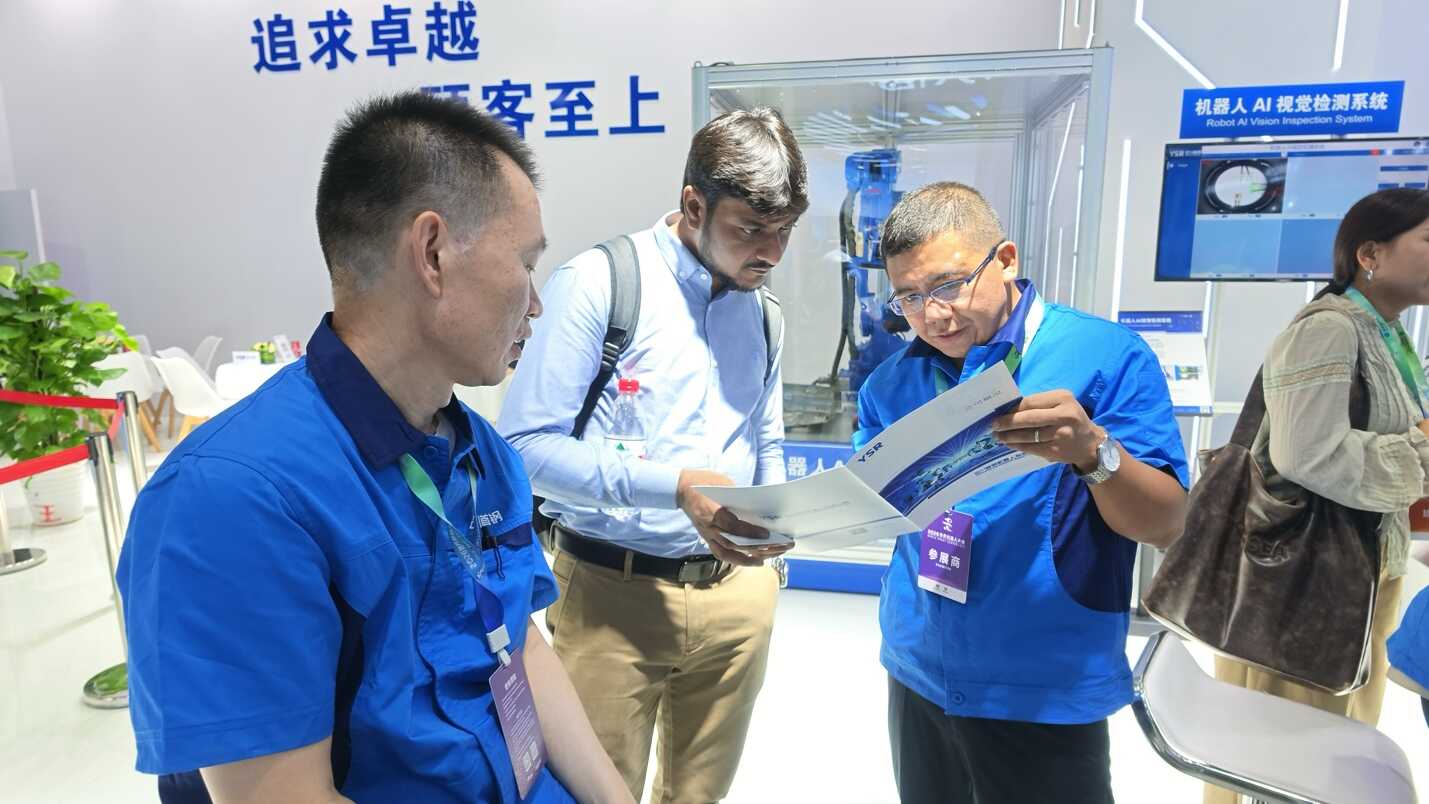
A Pakistani visitor speaks with exhibitors about a robot AI vision inspection system at the 2026 World Robot Conference in Beijing. [China Economic Net/ Xiong Weisheng]
One of the most concrete proposals came from Jacques Eone, president of the Cameroon Robotics Association and co-founder and CEO of robot and drone supplier Sparte Robotics. Chinese firms could strengthen deployment by building networks with local companies, he said, identifying agriculture and mining as priorities for Cameroon. Local partners could take on maintenance and software adaptation, he added, giving them a role in the robotics value chain.
Those needs take different forms across markets. Chee Fai Tan, president of the ASEAN Federation of Smart Industry, said Southeast Asian economies wanted to deploy more industrial robots as their automobile and semiconductor industries expanded, but said wider adoption would require workers who can integrate, program and adapt the systems. Bikash Gurung, president of the Robotics Association of Nepal, said cooperation could combine imports with local research and a national deployment strategy.
Skills will also shape how the economic gains are distributed. The World Bank's June 2025 "Future Jobs" report found that industrial robot adoption in Indonesia, Malaysia, the Philippines, Thailand and Viet Nam raised manufacturing employment and earnings overall, as productivity and scale gains outweighed displacement. Between 2018 and 2022, robot adoption created an estimated 2 million jobs for skilled formal workers while displacing 1.4 million low-skilled formal workers in routine and manual roles.
The new programme could meet part of that demand by letting suppliers and overseas partners test machines against local conditions.
(Editor: wangsu )