


by Liu Qiyu
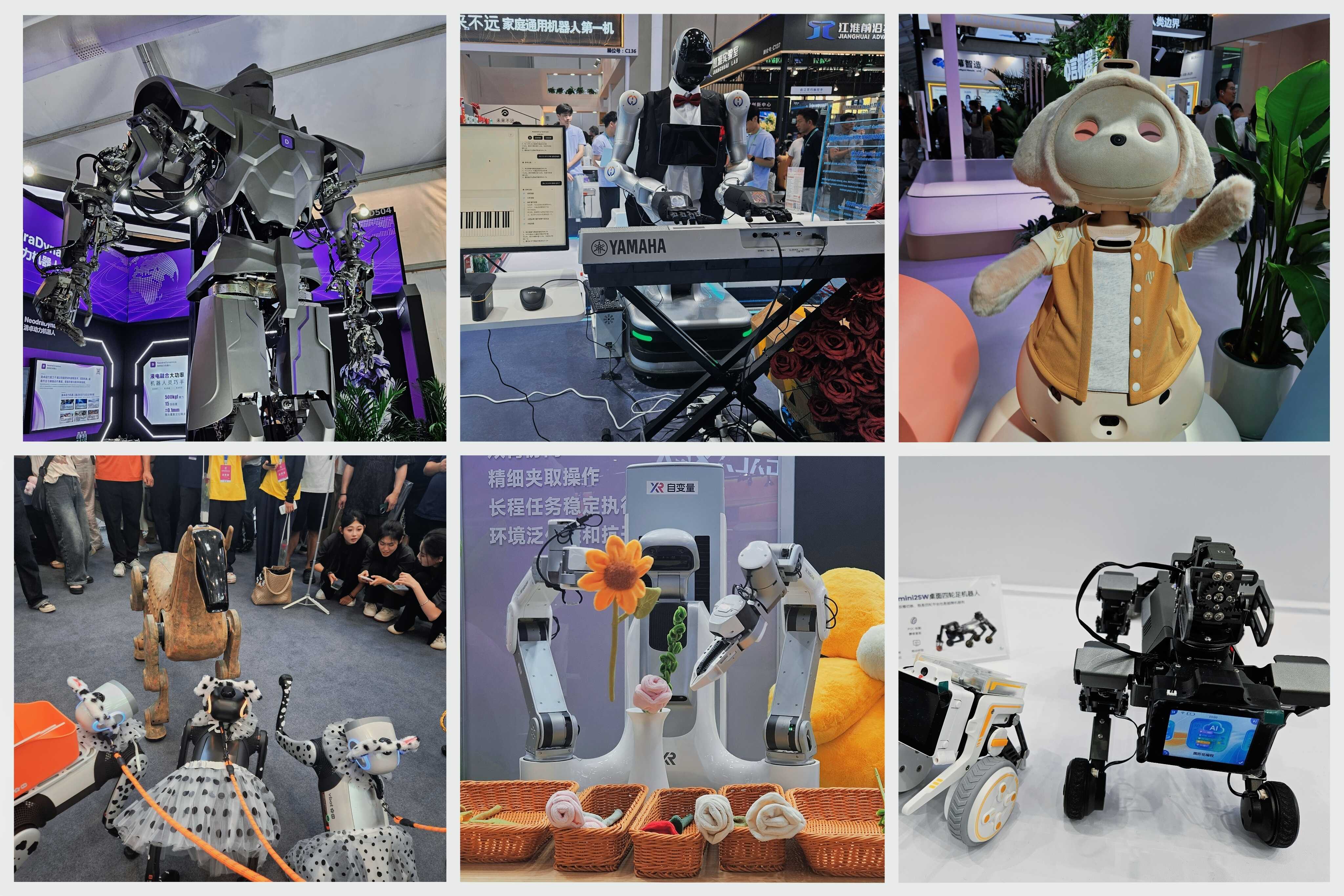
A selection of robots on display at the 2026 World Robot Conference in Beijing. [Photo/Liu Qiyu]
China's robot industry has spent the past few years trying to make machines cheaper, smarter and more capable. At this year's World Robot Conference in Beijing, some companies were also trying something less glamorous, namely, renting them out.
One household-service robot maker interviewed by China Economic Net at the conference charges 3,000 yuan (~$446) a month for a robot that costs more than 20,000 yuan to build. It initially offered one-day trials and weekly rentals of about 700 yuan before settling on the monthly model. The company is not yet offering long-term contracts; demand was already strong enough to push its booking schedule into December, while limiting customers to a month at a time allows the machines to circulate among more households.
That may sound like a small experiment in consumer financing. It is more interesting as a sign of how the robotics industry is trying to solve a problem that technology alone cannot, that is, persuading customers to use machines that are still evolving.
China already makes robots on a considerable scale. According to the National Bureau of Statistics, the country produced 635,056 industrial robots in the first seven months of 2026, up 28.5% from a year earlier, while service-robot output reached 12.14m units, up 12.2%. In July alone, industrial-robot output rose 30.2%. The question is no longer whether China can manufacture robots.
Now it is whether enough customers can find an economic reason to use them. According to figures released by the Shanghai Pudong government, China's robot-rental market exceeded 1bn yuan (~$148m) in 2025. iiMedia Research expects it to surpass 10bn yuan this year, a tenfold increase. Is robot rental up in China?
Why rent a robot?
For a hotel, that reason may not involve owning a robot at all.
Mark McGauley, founder and CEO of Norway-based Autobot Rentals, described a model in which it buys service robots from Chinese manufacturers, and rents them to hotels while handling installation and maintenance. The appeal is not only about spreading the cost of the hardware, but also about removing the technical work that comes with it, like mapping the building, connecting the robot to elevators and keeping the machine running.
"Rentals is a certain stage of commercialization," he said. In his view, robots may be easier to rent than to sell because they are still complicated for customers to understand and operate. That gives rental companies a role beyond financing. They can install the machines, maintain them and absorb much of the hassle, allowing companies to try robots without first developing the expertise to run them.
A hotel that buys a robot becomes, to some extent, a robotics operator. A hotel that rents one can treat it as another outsourced service.
This is the logic behind Robot-as-a-Service, or RaaS, and it is beginning to acquire official backing. In June, the Ministry of Industry and Information Technology and the State-owned Assets Supervision and Administration Commission of the State Council (SASAC) called for real-world testing of humanoid robots and embodied-intelligence systems, including evaluation of task success rates, efficiency gains, safety, reliability and economic feasibility. The notice explicitly encouraged RaaS models based on usage-based payments and operating leases to lower customers' upfront costs and accelerate commercial deployment. It also aims to generate more than 100 high-value application scenarios and build the capacity for deployment at the scale of tens of thousands of units by the end of 2026.
The timing is telling. Leasing makes particular sense when the technology is improving faster than the customer's willingness to commit capital.
A hotel may be happy to experiment with a delivery robot, but less happy to spend a large sum on a machine that could become obsolete, require specialist maintenance or fail to justify itself after the novelty wears off. Renting transfers some of that risk to the supplier, which can upgrade or replace the equipment while keeping the customer focused on the service it provides.
Beijing is trying to make that calculation easier. A policy issued by the Beijing Economic-Technological Development Area encourages robot financing leases and provides subsidies equal to 10% of rental costs for qualifying projects, capped at 3m yuan per enterprise a year.
The policy also supports insurance for humanoid robots, another indication that the authorities see financing, risk and after-sales service as part of the commercialisation problem rather than as peripheral concerns.
The customer may also be the test site
The household market reveals an even more unusual reason to rent - the robot needs to learn.
The Shanghai-based Futuring Robot charging 3,000 yuan a month says it wants its machines to enter more homes, partly to discover new needs and test how reliably they work in different environments.
Louis Shen, Co-founder of Futuring Robot suggested that some low-priced household rental schemes are not primarily designed to make money from rent. Their strategic value is the opportunity to collect data from real homes and use it to train world models.
This turns the normal economics of leasing upside down.
A conventional lessor wants an asset to remain with one customer for as long as possible. A robot company may prefer the opposite. The more homes a machine visits, the more varied the data it can collect. The rental contract becomes both a commercial transaction and a field test.
That matters because the home is a particularly difficult environment for embodied AI. A robot that works reliably in one carefully prepared demonstration area may behave very differently in a hundred ordinary homes. Factories can be designed around machines; homes cannot. Furniture moves, objects are left in unexpected places, children and pets interfere, and every household has different habits.
There is another uncertainty that becomes more important as robots become more human-like, which is, what users expect from them. Xavi García Gandía, founder of Spain-based Homo Robotis Labs said the need for a humanoid machine ultimately depends on the application. Garcia with more than 30 years of experience in industrial and agricultural robotics also warned that anthropomorphism can raise the psychological stakes. When a highly human-like robot fails, users may feel more frustrated, or even react aggressively, whereas a conventional-looking machine is more likely to be treated simply as a malfunctioning piece of equipment.
That makes experimentation more valuable. A customer renting a robot can discover not only whether the machine works, but whether its form and behaviour match what people actually expect from it.
Paying for the job, not the machine
The same principle applies to industrial robots, though the economics are harsher.
Jens Peder Kristensen, Founder and CEO of Denmark-based KeyResearch, told China Economic Net that deployment should proceed from simple to complex. If a factory needs a mobile manipulator, he said, a wheeled platform may be more practical than a full-size bipedal humanoid; legs should be introduced when the environment actually requires them, rather than because the machine looks more human.
His argument gets to the central issue for the rental business, this means at this stage a certain amount of customers are not renting humanoid robots because they want humanoid robots. They are renting machines because they want a task performed.
That distinction is likely to determine which part of the rental market survives. Robots used for exhibitions, performances or promotional events can generate short-term rental revenue, but their demand is inherently episodic. A machine that delivers goods in a hotel, moves materials in a warehouse or performs a repetitive industrial task has a much stronger claim to recurring revenue.
The more predictable the task, the easier it is to price the robot as a service.
In that sense, the eventual unit of sale may not be a robot at all. It could be a completed delivery, a moved box, an inspected component or an hour of machine labour. The customer would not need to know how much the hardware costs, any more than a company hiring a cleaning service needs to own the cleaner's vacuum cleaner.
China's rental experiments are still small compared with the country's enormous manufacturing base, and the economics remain uncertain. But that is precisely why they are worth watching.
The industry is discovering that the obstacle to robot adoption may not simply be the price of the machine. It is the fact that customers are being asked to make a long-term investment in technology whose capabilities, reliability and useful life are still changing.
Renting lowers that barrier. It gives customers a way to try a machine without owning it, gives manufacturers a way to keep upgrading it, and—particularly in households—gives robots access to the messy environments in which embodied AI ultimately has to work.
For customers, the value of a robot may ultimately lie less in owning the machine than in paying for the work it performs. The industry's long-term ambition is not to persuade every household or hotel to own a robot. It is to make the robot cheap and reliable enough that customers no longer care who owns it.
(Editor: liaoyifan )