


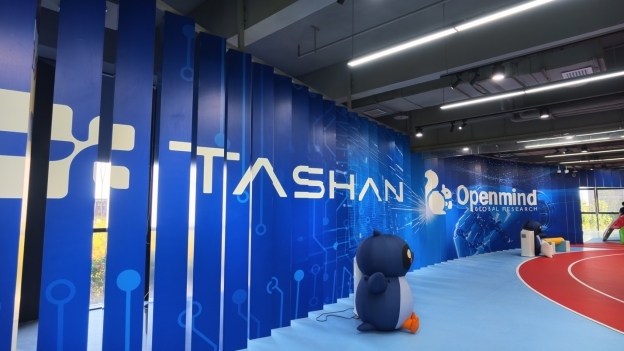
The interior of the Robot Kindergarten jointly developed by Tashan Technology and Richard Sutton’s Openmind Global Research team at Beijing’s Shougang Park. [China Economic Net/ Xiong Weisheng]
by Xiong Weisheng
BEIJING, Sept 2 (China Economic Net) - Turing Award winner Richard Sutton and Chinese tactile-sensor maker Tashan Technology opened a robot "kindergarten" in Beijing on Tuesday, betting that machines can learn to handle the physical world if they are allowed to make mistakes.
About 10 robots, most of them humanoid, ran, walked and waved across activity zones at the site in Shougang Park, a former steelworks being redeveloped as a technology hub. Human operators steered them by remote control during a media tour.
Tashan said the site covered two floors, divided into areas for testing, learning and interaction, and that it had begun recruiting partners including robot makers, sensor firms, algorithm teams and universities.
The venture grew out of an agreement signed in Edmonton, Canada, on May 11. Sutton, a University of Alberta professor who founded Openmind Global Research, shared the 2024 Turing Award, computing's highest honour, with Andrew Barto for work that laid the foundations of reinforcement learning, in which machines improve through trial and error.
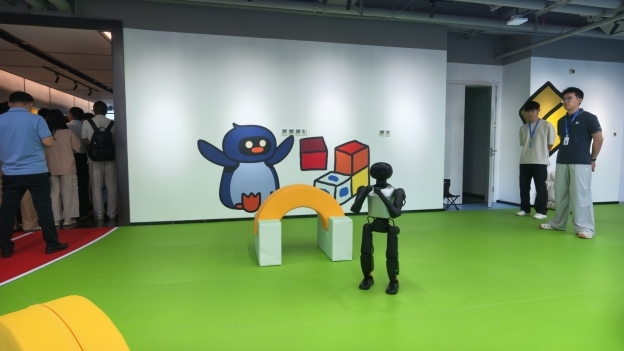
A humanoid robot performs a task inside the Robot Kindergarten at Beijing’s Shougang Park. [China Economic Net/ Xiong Weisheng]
"All my time in artificial intelligence, for close to 50 years, we wanted to have robots learn from experience," Sutton said at the opening ceremony.
Much robot training today relies on human demonstrations, remote-control data or simulation, said Dr. Kris De Asis, a senior research fellow at Openmind. Once trained, the behaviour is frozen and loaded onto the robot, which then stops learning. The Beijing project aims to let robots keep learning after they are put to work, from the consequences of their own actions.
He gave the example of a factory arm whose joints loosen with wear. Rather than have an engineer restore the hardware to its original precision, a learning robot could adapt and re-learn a reliable pick-and-place motion.
The near-term bottleneck is hardware, De Asis said. A robot that breaks after falling over a few times cannot learn, whatever the algorithm.
"If it can't make a mistake, then it can't learn," he told reporters on the sidelines of the opening.
Tashan, founded in Beijing in 2017, makes tactile-sensing chips, fingertip sensors and electronic skin. De Asis said some of the project's first milestones involved making robots robust enough to fall, using touch and temperature sensors to trigger hard-coded protective reflexes. Touch also matters for handling soft or fragile objects. A camera watching an egg shows the grip is too tight only once it is too late.
De Asis said a small spider-like robot with no prior training learned to walk forward on real hardware in "maybe 40 minutes", rewarded only for moving ahead.
He called that a very specific case, and said it was not clear how long a more capable robot would take to learn general skills.
But people may be impatient with robots, De Asis said. A baby takes years to master grasping, and a robot could be allowed the same, since what one machine learns can be saved and transferred to others.
(Editor: fubo )