


by Liao Yifan
BEIJING, Sept. 9 (China Economic Net) -- As China and Pakistan face shared challenges including soil degradation, environmental pollution and the need to strengthen climate-resilient agriculture, researchers from the two countries are deepening cooperation through joint research, project applications and academic exchanges.
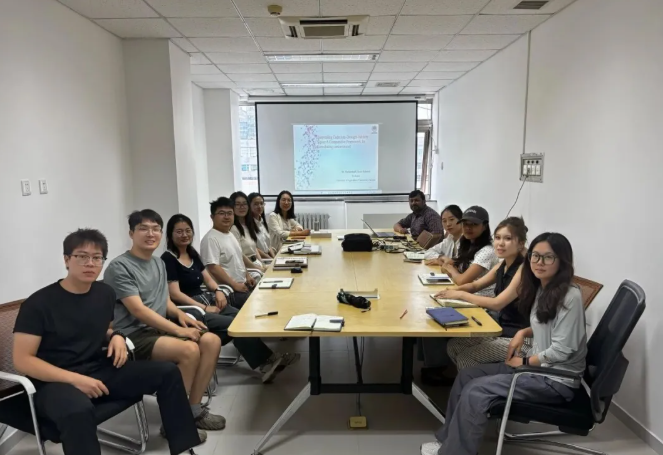
Muhammad Zia-ur-Rehman, a professor at the Institute of Soil and Environmental Sciences of the University of Agriculture Faisalabad in Pakistan, recently visited the Institute of Environment and Sustainable Development in Agriculture (IEDA) of the Chinese Academy of Agricultural Sciences (CAAS) as a foreign expert.
The visit was an extension of an ongoing scientific partnership between Zia-ur-Rehman and Professor Li Hongna and her team at IEDA. The two sides have been cooperating since 2019, with their work covering scientific exchanges, joint research and applications for research funding.
The latest visit also came as several joint research initiatives were moving forward. A project previously submitted by the two researchers in China had been shortlisted for further review, allowing Zia-ur-Rehman to participate in the proposal defense in person. Meanwhile, joint proposals submitted in Pakistan were under review by the Pakistan Science Foundation and the Punjab Agriculture Research Board.
For Zia-ur-Rehman, the value of China-Pakistan agricultural cooperation lies partly in the complementary strengths of the two countries.
"China has made remarkable advances in agricultural science, technology, and research infrastructure, while Pakistan offers diverse agro-ecological conditions and a strong need for joint experimentation under open field conditions," he told China Economic Net.
He noted that both countries face common challenges, including soil degradation, the safe management of organic waste and the development of climate-resilient agriculture under changing environmental conditions. Academic exchanges, he said, could combine China's technological and institutional strengths with Pakistan's field experience and local knowledge.
The challenges are becoming increasingly significant as climate change puts additional pressure on agricultural production and food security. Zia-ur-Rehman said joint research on soil health and the safe management of municipal and agricultural waste could help reduce environmental risks while improving soil fertility and crop productivity, which is directly linked to food security.
The researchers are also looking beyond traditional environmental concerns to emerging issues in agricultural ecosystems. Future cooperation could include research into pollutants such as microplastics and antibiotic resistance, as well as their environmental behavior and possible remediation approaches.
The partnership has already produced tangible results, including a joint publication and a shared research direction on the safe management of municipal waste and crop residues in agricultural soils.
"Seeing an idea move from initial discussion to a funded, published, and now further-developed line of research is one of the most rewarding parts of international collaboration," Zia-ur-Rehman said.
Looking ahead, the two sides hope to expand cooperation in climate-resilient agriculture and environmental research, while strengthening exchanges of graduate students and young researchers, joint supervision and co-authored publications.
Zia-ur-Rehman said closer academic cooperation could create "a pipeline of trained young scientists in both countries," encourage mutual funding mechanisms that make more ambitious projects possible, and allow knowledge and technology to move in both directions rather than just one.
He also expressed hope that the cooperation could eventually develop into a joint laboratory or research platform focusing on soil health and sustainable waste management.
"Closer cooperation can accelerate practical solutions to shared problems," he said, adding that stronger academic partnerships can build lasting institutional relationships and promote the two-way exchange of knowledge and technology.
The latest exchange highlights how China-Pakistan agricultural cooperation is expanding from academic exchanges and individual research projects toward longer-term collaboration in research, talent development and sustainable agriculture.
(Editor: wangsu )