


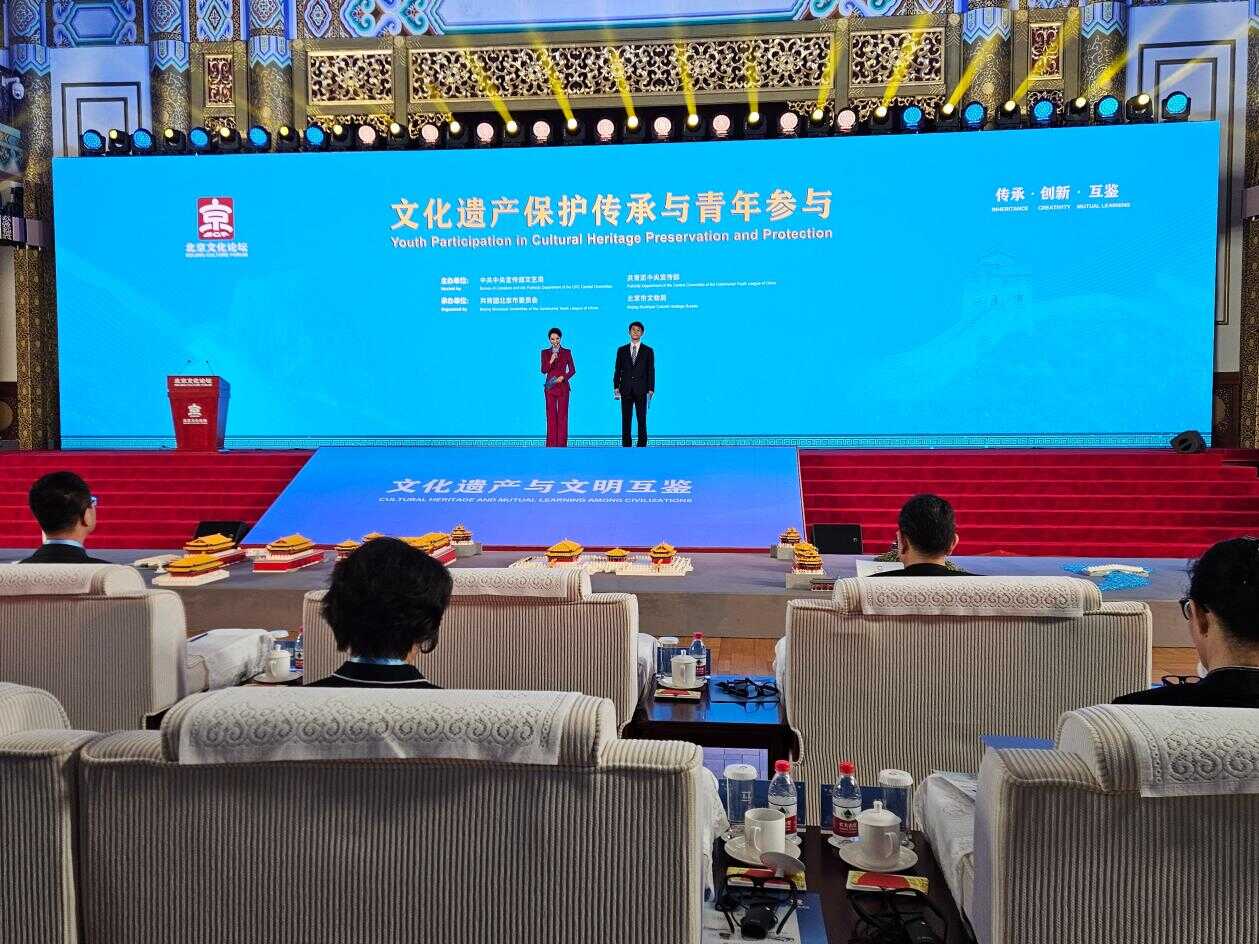
BEIJING, Sept. 24 (China Economic Net) - Young people are taking on more active roles in protecting and presenting cultural heritage, from using digital tools to document ancient sites to finding new ways of connecting traditional culture with contemporary audiences.
The issue was highlighted at a parallel forum on youth participation in the protection and inheritance of cultural heritage, held on Sept. 23 as part of the 2026 Beijing Culture Forum, themed “Cultural Heritage and Mutual Learning among Civilizations.”
At the Dunhuang Academy, digital technology has become an important tool for heritage preservation and public engagement. Ding Xiaohong, Deputy Director of the Cultural Heritage Digitalization Research Institute at the Dunhuang Academy, outlined the development of “Digital Dunhuang,” which uses technologies including high-resolution imaging and 3D reconstruction to document grottoes, murals and sculptures. The institute’s team has grown from more than 10 people to over 140, with those under 35 accounting for 52 percent.
Young archaeologists are also contributing through painstaking fieldwork. Zhong Fangrong, an archaeologist at the Dunhuang Academy, described her work documenting caves and archaeological material, including details that may only prove valuable to researchers decades later. Her experience reflects the long-term commitment required in heritage protection.
In Beijing’s Dongcheng district, youth participation has taken a more community-oriented form. Sun Xinjun, Secretary of the CPC Dongcheng District Committee, described the relationship between young people and the old city as moving from empathy to co-creation. The district has combined heritage conservation with youth activities, creative competitions and digital and audiovisual projects, while maintaining restoration principles such as preserving historical authenticity and minimizing intervention.
The international dimension was illustrated by Carlos Vásquez, Ambassador of Peru to China, who highlighted exchanges between young people in China and Peru around their respective ancient civilizations. Peru has presented exhibitions in Beijing and Shanghai this year, while young journalists and audiences in China have also been introduced to Peruvian heritage through exhibitions, media programs and online activities.
Li Ziqi, an internationally renowned vlogger, brought the discussion into the digital age, sharing her experience of presenting traditional crafts and everyday Chinese culture through short videos. Her work shows how online platforms can connect cultural heritage with audiences far beyond its place of origin.
The forum also released the “Youth Initiative on the Protection and Inheritance of Cultural Heritage,” calling on young people around the world to participate in protecting and carrying forward shared cultural heritage.
(Editor: wangsu )