

CHENGDU, Oct 15 (China Economic Net) - The Islamia University of Bahawalpur (IUB) and Sichuan Agricultural University (SAU) have renewed their Memorandum of Understanding (MoU) for another five years, reaffirming their commitment to strengthening Pakistan-China cooperation in agricultural research and food security.
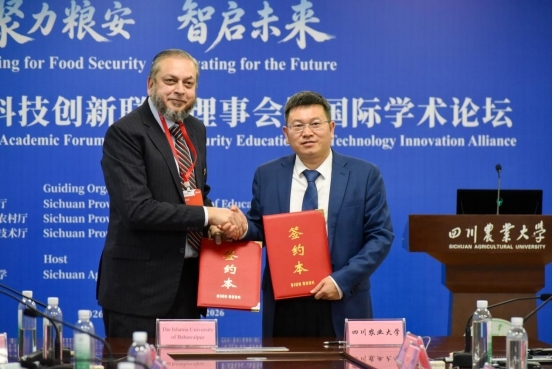
The Islamia University of Bahawalpur and Sichuan Agricultural University renew their MoU. [Photo/SAU]
The agreement was renewed during SAU’s 120th anniversary celebrations in Chengdu, Sichuan province, attended by IUB Vice Chancellor Prof. Dr. Muhammad Kamran and Dr. Muhammad Ali Raza, director of IUB’s National Research Center of Intercropping (NRCI).
Highlighting the achievements of the partnership, Kamran said the establishment of NRCI was one of its most significant outcomes. The center adapts and optimizes Chinese intercropping technologies to address the specific needs of Pakistani farmers.
NRCI has developed and optimized maize-soybean, sugarcane-soybean and cotton-soybean strip intercropping technologies, which are now being cultivated on more than 180,000 mu (12,000 hectares) of farmland across Pakistan, with adoption continuing to expand. The center is led by Dr. Raza and Dr. Haider, both alumni of SAU.
“Building on this success, our researchers are now advancing next-generation wheat-based and sugarcane-based intercropping systems, with particular emphasis on improving the efficiency of land, nutrient and water use, enhancing climate resilience, and promoting sustainable productivity,” Kamran said.
Since the partnership began in 2021, 56 IUB students have received fully funded scholarships to pursue master’s and doctoral degrees at SAU, according to information provided by IUB.
IUB is also the only Pakistani institution serving on the Standing Council of the Food Security Education and Technology Innovation Alliance (FSETIA), an international platform initiated by SAU to promote cooperation in food security research and innovation.
(Editor: fubo )