


SHANGHAI, Oct. 23, (China Economic Net) - A cross-cultural design blending Pakistani and Chinese folk traditions has earned international recognition in Shanghai, highlighting the role of creative collaboration in fostering people-to-people exchanges.
Hira Ali, a Pakistani artist, received a Cultural Exchange Award at the 4th ISFS Award of the International Folk Gifts Innovative Design Contest for her work “Folk Hues: Kalash and Jinshan Color Fusion.” The contest, hosted by the Shanghai Fashion and Accessories Society, held its final evaluation meeting on October 19 at Donghua University. Her tutor, Wu Pengxiao from Shanghai University, received an Excellent Tutor Award.
The competition, themed “Algorithm,” used baseball caps, scarves, T-shirts, and socks as design carriers, encouraging domestic and international students at Chinese universities to explore and interpret folk cultural elements from around the world. Through their designs, participants were invited to express the fashion essence of diverse local folk cultures and jointly build a more inclusive, green and intelligent future.
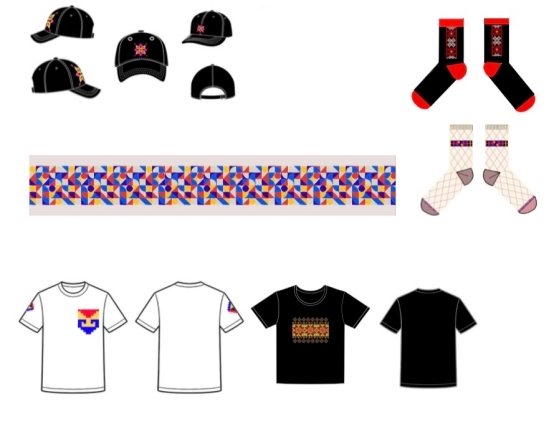
Hira Ali’s award-winning design fuses Pakistani Kalash elements with Shanghai Jinshan Farmer Paintings, photo provided to CEN
Hira Ali’s award-winning design fuses Pakistani Kalash elements with Shanghai Jinshan Farmer Paintings. The Kalash, a small indigenous people of Pakistan’s Chitral region, retain ancient folk beliefs, Kalasha language and distinctive embroidered dress, and their Suri Jagek astronomical practice was inscribed by UNESCO in 2018 as an intangible heritage in need of urgent preservation.
Celebrated for their bold compositions and vibrant colors, the Jinshan Farmer Paintings, which emerged in Shanghai’s Jinshan district in the late 1950s, gained international recognition after an exhibition at the National Art Museum of China in 1980, and are now recognized as Shanghai's municipal intangible cultural heritage.
“I selected Kalash civilization as creative inspiration for its authentic, distinctive folk textile motifs, transforming this indigenous heritage into modern apparel design to showcase unique tribal charm,” Hira Ali said. The cross-cultural fusion aims to highlight Shanghai’s intangible heritage while integrating international folk aesthetics. Though geographically and culturally distinct, both arts share the same core aesthetic of vibrant, high-contrast, life-driven color palettes rooted in local daily life and natural landscapes.
(Editor: fubo )