


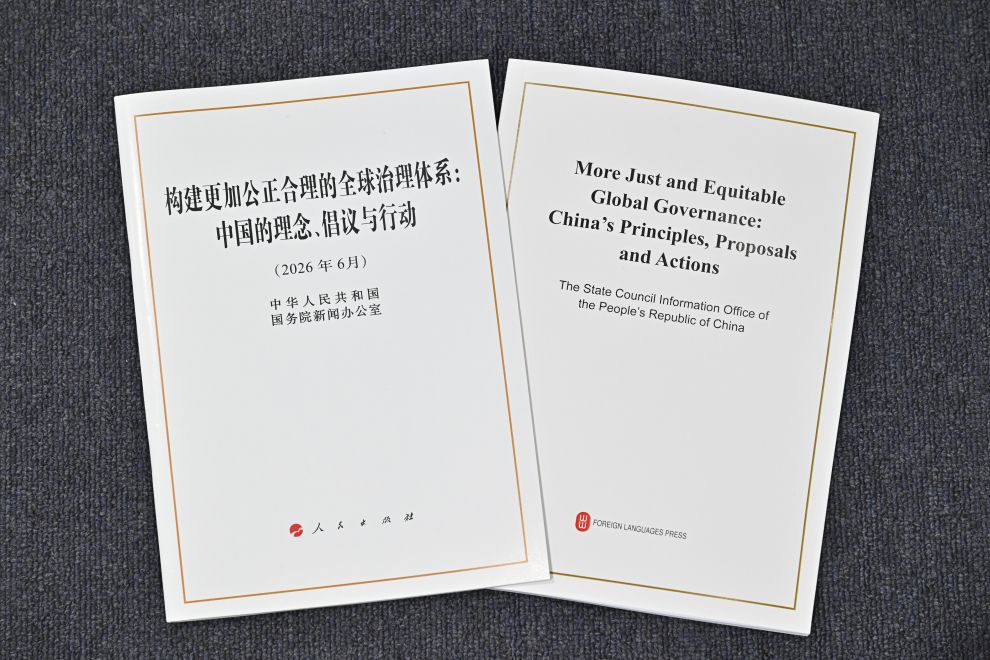
This photo shows the Chinese and English editions of a white paper titled "More Just and Equitable Global Governance: China's Principles, Proposals and Actions" released by the State Council Information Office (SCIO) on June 17, 2026. (Xinhua/Li Xin)
BEIJING, Oct. 23 (Xinhua) -- Global governance must evolve to reflect the realities of today's world and respond more effectively to the needs of all countries, especially developing ones.
As the 2026 Global Governance Forum (Xiongan) convenes, China's Global Governance Initiative (GGI) offers a timely framework for addressing this challenge through reform and improvement of the existing system.
The need for change is growing ever more urgent. Development gaps remain wide, inequalities persist, and challenges ranging from climate change to debt distress continue to weigh heavily on developing countries.
Yet, the current international institutions and global governance mechanisms tasked with addressing these issues do not always adequately reflect the changing distribution of global economic strength or give all countries an equal voice in making decisions that affect them.
At the core of the current strain on the system lies a glaring representation gap. While emerging economies have become increasingly important drivers of global growth, their representation in some key decision-making bodies remains inadequate. As the global economic and demographic center of gravity shifts, this disparity is becoming difficult to ignore.
The Global South should not remain a passive recipient of rules shaped by others. It must have a greater say in setting the global agenda and shaping international rules. Improving the representation of developing countries in global governance institutions is not a concession by the West, but a necessary adjustment to make the system more inclusive, representative and effective.
Such reform would benefit the international community as a whole. The world is a single ship carrying all nations; its stability depends on their ability to meet shared challenges together. A governance system that fails to accommodate the legitimate concerns of a large part of the world will struggle to muster the collective response that global challenges require.
Fairer representation, however, is only part of the answer. Global governance must also be judged by whether it improves people's wellbeing and delivers tangible results. International cooperation should serve ordinary people, and commitments made at the global level must translate into practical progress on the ground.
These principles are central to the GGI, which sets out five core concepts: adhering to sovereign equality, abiding by the international rule of law, practicing multilateralism, advocating a people-centered approach, and focusing on taking real actions. The Initiative has gained support from nearly 160 countries and international organizations, while more than 60 countries have joined the Group of Friends of Global Governance.
At its core, the GGI calls for global governance to keep pace with changing times while upholding the purposes and principles of the UN Charter. It seeks to reform and improve the existing global governance system, rather than to overturn the international order. The objective is to make multilateral institutions more responsive to today's challenges and better equipped to deliver results for the international community.
This distinction matters. Reforming global governance is not a zero-sum game in which a greater role for the Global South must come at the expense of other countries. Nor is it about replacing one set of rules with another. It is about making international institutions more representative of the world as it is today, while strengthening the common rules and cooperation needed to address shared challenges.
At a time when the world faces mounting uncertainties and increasingly interconnected challenges, the task is not simply to discuss what needs to change, but to build greater consensus on how to make global governance more inclusive, effective and action-oriented.
By giving all countries a greater voice, putting people at the center and turning commitments into concrete results, the global community can build a system tailored to better meet challenges of our time.
(Editor: fubo )