


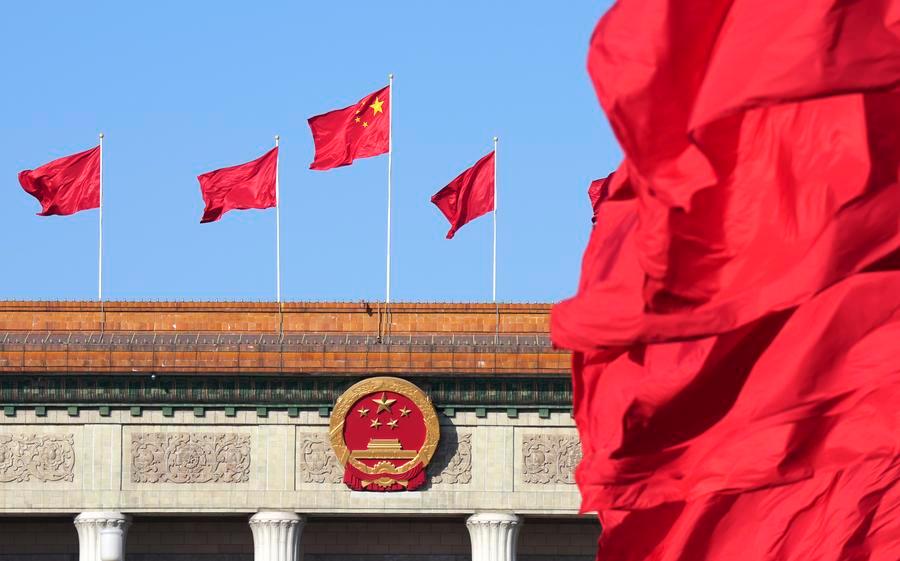
This photo taken on March 11, 2026 shows the Great Hall of the People, the venue for the closing meeting of the fourth session of the 14th National Committee of the Chinese People's Political Consultative Conference (CPPCC), in Beijing, capital of China. (Xinhua/Wang Xi)
BEIJING, Oct. 26 (Xinhua) -- With more than 100 million members and the responsibility of governing a country of over 1.4 billion people, the Communist Party of China (CPC) faces an enduring task: identifying and addressing issues within its own ranks.
The task has taken on fresh relevance as the CPC prepares to convene the fifth plenary session of its 20th Central Committee in Beijing on Monday. The four-day meeting is scheduled to deliberate on a draft decision on several major issues on persistently advancing full and rigorous Party self-governance.
As Chinese President Xi Jinping, also general secretary of the CPC Central Committee, has pointed out, the CPC's full and rigorous self-governance is a great practice in the Party's self-reform in the new era, and has created a new frontier in its self-reform.
WHY PERSISTENT SELF-REFORM?
At a gathering marking the CPC's 105th founding anniversary in July, Xi said the Party focuses on self-strengthening and always brims with vigor and vitality, referring to it as one of its fine qualities with no parallel among other political parties and political forces.
In its pursuit of a better life for the Chinese people, the Party has addressed development challenges through comprehensively deepening reform, while pursuing self-reform to enhance its governing capacity.
Since the reform and opening-up in 1978, China has undergone profound transformations. Having achieved tremendous success from humble beginnings, reform efforts have now entered a "deep-water zone." Xi once compared the remaining difficult reforms as "tough bones that are hard to chew."
As reforms have advanced into more complex stages, the CPC views full and rigorous governance of the Party as an essential guarantee. Under the banner of self-reform, the CPC has made persistent efforts to improve Party conduct, build a clean government and fight corruption.
Haris Bilal Malik, a research fellow at the Institute of Strategic Studies Islamabad in Pakistan, said the CPC's approach treated self-reform as a continuing responsibility of the governing organization. Internal inspections, disciplinary supervision and anti-corruption measures were intended to identify organizational weaknesses, enforce standards of conduct and strengthen policy implementation, he said.
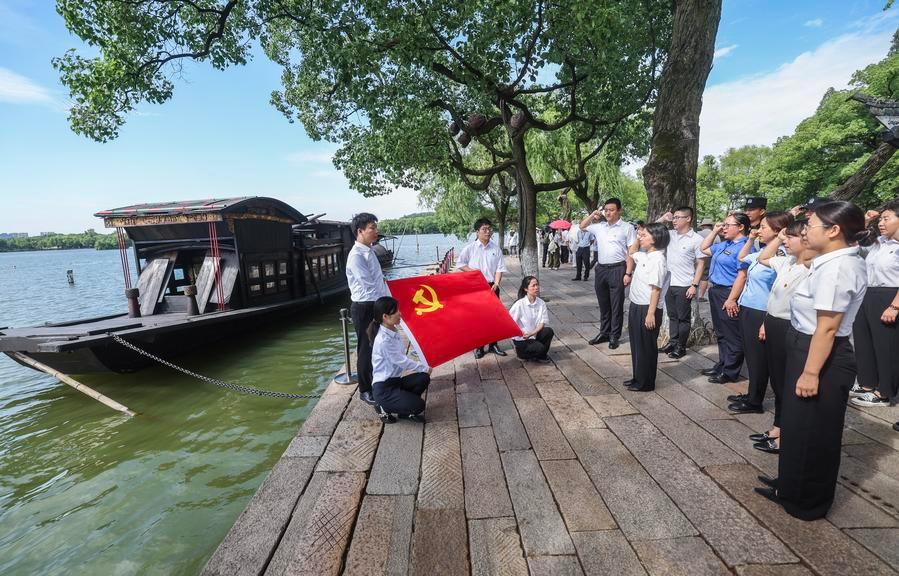
Members of Communist Party of China (CPC) review the Party admission oath beside the replica of a boat, now referred to as the Red Boat, on which CPC founders concluded their meeting in 1921, on Nanhu Lake in Jiaxing, east China's Zhejiang Province, June 30, 2025. (Xinhua/Xu Yu)
Helga Zepp-LaRouche, founder and president of the Schiller Institute, linked the CPC's concept of self-reform to the Confucian tradition of lifelong learning and self-improvement. She said improving governance capacity required a political culture within the Party that was oriented toward serving the people.
Volker Tschapke, honorary president of Germany's Prussian Society, said the CPC's efforts went beyond short-term campaigns, reflecting a commitment to continuous self-examination.
"This is not for show, this is character," he told Xinhua.
HOW DOES OVERSIGHT BECOME ROUTINE?
A central question is how self-reform efforts can bring about lasting changes in how officials and institutions operate.
The central Party leadership's eight-point decision on improving work conduct, adopted in December 2012, set out rules governing research tours, meetings, documentation and other official duties. Its implementation has targeted problems ranging from the misuse of public funds for holiday gifts to misconduct outside working hours, with regulations, inspections and disciplinary measures reinforcing compliance.
Anti-corruption efforts have also continued. China's top anti-graft authorities filed cases against 181 officials directly administered by the Organization Department of the Central Committee of the CPC in 2025, according to the work report of the fifth plenary session of the 20th Central Commission for Discipline Inspection.
The work report also revealed that discipline inspection and supervisory authorities filed more than 1 million cases in 2025 and placed 47,000 individuals under detention. A total of 983,000 people received Party disciplinary or administrative punishment. Some 26,000 individuals voluntarily surrendered.
Pavel Troshchinsky, a lead researcher at the Russian Academy of Sciences' Institute of China and Contemporary Asia, said China's anti-corruption efforts had moved from "paper requirements" to "real action."
He highlighted the CPC's emphasis on ensuring that officials dare not, cannot and will not engage in corruption, combining punishment, institutional restraints and stronger ethical awareness.
The CPC has also institutionalized regular inspections to assess whether Party organizations are implementing central decisions, exercising power properly and fulfilling their responsibilities. Inspection teams identify problems and provide feedback, while the organizations concerned must take corrective action under follow-up supervision.
In 2025, the fifth and sixth rounds of inspections under the 20th CPC Central Committee were carried out in succession, completing full coverage of all provincial-level regions.
The emphasis on corrective action can also be seen in China's environmental governance. Central environmental inspections examine whether local Party committees and governments are fulfilling their environmental protection responsibilities.
Following the first round of inspections, which covered all 31 provincial-level regions by the end of 2017, inspection teams conducted a major follow-up review in 2018, covering 20 regions in two batches. Regulations issued in 2025 also provide for follow-up reviews of corrective action when necessary.
In south China's Guangdong Province, inspectors found in 2018 that efforts to tackle pollution in the Lianjiang River had made insufficient progress. The findings prompted local authorities to accelerate wastewater treatment projects and tighten controls on industrial discharges. The river's water quality has since improved through sustained cleanup efforts.
HOW DOES DISCIPLINE SHAPE DEVELOPMENT?

A farmer shows an edible fungus cultivated with the Juncao technology at Yuanyi Village of Minning Town, Yongning County of Yinchuan, northwest China's Ningxia Hui Autonomous Region, Sept. 11, 2026. (Xinhua/Yang Zhisen)
The effects of discipline and oversight extend beyond official conduct to the management of public resources and the implementation of development policies.
Efforts to tackle corruption and misconduct in school meal programs offer an example. In 2025, disciplinary and supervisory authorities across China handled 61,000 cases involving corruption and misconduct in such programs, with 35,000 people receiving Party disciplinary or administrative sanctions, according to a report published in February 2026.
The authorities also pushed for tighter oversight of school meal funds, procurement and food safety.
Waleed Gaballah, a member of the Egyptian Association for Political Economy, Statistics and Legislation, said full and rigorous Party self-governance could strengthen fiscal discipline by curbing the misuse of public funds, reducing waste and improving the implementation of development projects.
Emmanuel Matambo, research director of the Center for Africa-China Studies at the University of Johannesburg, said China's experience highlighted the importance of combining development commitments with the ability to recognize shortcomings and correct mistakes.
Drawing on China's economic transformation and poverty reduction achievements, he emphasized that governing parties must ensure their policies deliver tangible benefits to the public.
Tschapke drew on his visits to China to describe the changes he had witnessed in rural communities and infrastructure.
"I have seen with my own eyes what has been achieved: how villages have blossomed through targeted poverty alleviation, how rural areas have found new hope, how high-speed rail connects people and hearts," he said.
He associated those changes with the CPC's emphasis on public welfare and its efforts to ensure that resources reach the grassroots.
Ruslan Yesin, head of the Department of Comprehensive Chinese Studies at Belarusian State University, attributed the CPC's governance achievements to its combination of long-term planning and pragmatic implementation, commitment to mutually beneficial international cooperation, and people-centered approach to development.
Yesin said China's experience offers valuable lessons for the Global South in sustaining steady growth, improving livelihoods and enhancing the capacity for independent development.
(Editor: wangsu )