


"'Harmony in diversity', grounded in peaceful coexistence and pursuing win-win cooperation, provides an intellectual foundation for addressing today's global governance challenges," Robert Walker, fellow of the Royal Society of Arts and the Academy of Social Sciences, Britain, said during an interview on the sidelines of the 2026 Hehe Culture Forum in Taizhou, Zhejiang Province, China on Tuesday.
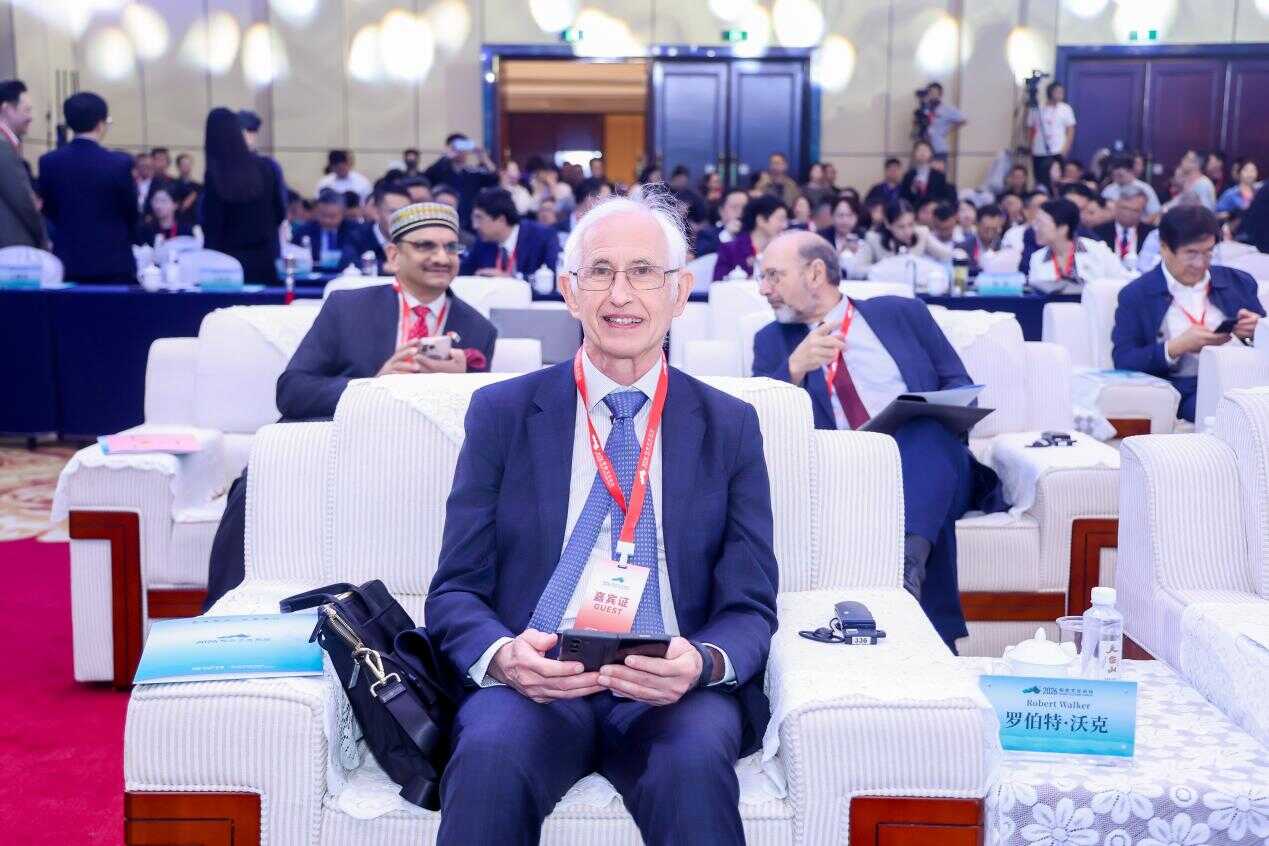
Robert Walker, fellow of the Royal Society of Arts and the Academy of Social Sciences, Britain.
At the conference, which attracted more than 220 guests representing 23 countries across five continents, Ryan Perkins, chief analyst at the Global Economic Index and a British economist, told China Economic Net that ordinary consumers in the United States prefer closer relations with China for the economic benefits of trade. Access to high-quality, competitively priced Chinese goods, he said, "gives consumers a tangible stake in continued economic cooperation and the benefits of a multipolar world."
Perkins also pointed to mounting structural pressures within the US financial system.
"The U.S. financial system is grappling with structural problems accumulated over decades, most notably an inflated derivatives market whose notional value stands at roughly seven times global GDP, an estimated $640 trillion, creating inherent instability. Compounding this is an AI bubble: large-scale monetary expansion during the pandemic transferred wealth toward the financial sector, with vast sums of capital flooding into AI rather than being grounded in actual return expectations," he said.
Liquidity pressures have already emerged in the bond market, private credit and the life insurance sector. Combined with unrealized losses and other vulnerabilities, these strains could, he warned, trigger a systemic crisis.
Ding Yifan, a senior fellow at the Development Research Center of China's State Council, approached the issue from the perspective of trade. More than 60 percent of China-US trade consists of intermediate goods embedded in global supply chains, he noted. Tariffs on Chinese imports can therefore hurt American manufacturers further down the production chain, creating costs for the very businesses such measures are intended to protect.
In effect, he suggested, the policy risks inflicting disproportionate damage on US' domestic economy.
APEC to Set Steadier Course
"Despite years of tariff disputes, broader economic tensions and reciprocal sanctions since 2018, China–US relations have recently shown signs of stabilization, with Beijing and Washington reaching a new level of understanding," Richard Sakwa, Emeritus Professor of the University of Kent said.
The upcoming APEC meeting, scheduled to take place in Shenzhen on November 18–19, 2026, could offer an important opportunity to build on that momentum.
"APEC demonstrates how economies of different sizes and political systems can coexist and cooperate," Sakwa argued. "Its approach offers lessons for the Global North at a time when international economic relations face mounting strains."
The implications of more stable China–US relations could extend well beyond trade. Sakwa suggested that improved ties might help create a framework for addressing the Russia–Ukraine conflict and easing the divisions that have deepened across Europe.
More broadly, he called for a shift in Western political thinking away from confrontation and toward peace, development and cooperation.
Walker highlighted APEC's potential role in addressing broader imbalances in the global economy. Its member economies account for about 60 percent of global GDP, making the forum an important platform for discussing trade imbalances, reform of the World Trade Organization (WTO), and disparities in influence within institutions such as the International Monetary Fund and the World Bank.
"Unlike arrangements built around rigid treaty obligations, APEC relies on consensus and flexibility. This allows economies with different priorities and political systems to engage with one another," Walker said.
"For small and medium-sized countries, an easing of China-US tensions will create a safer environment for other countries, promote complementarity of knowledge and capacity, and maximize the efficiency of global resource utilization," he said.
Pang Ruizhi, Associate Research Fellow of Chinese Academy of Social Sciences, the offered a further perspective on the conditions needed for a more stable relationship. China advocates an international order grounded in the purposes and principles of the UN Charter, he said, while the United States invokes a "rules-based international order" and, sometimes pursues predatory diplomatic policies.
A lasting strategic balance, Pang argued, would require both sides to reach at least a basic understanding of international rules and to move toward a more balanced distribution of power. Without such a foundation, continued US pursuit of hegemonic policies would undermine the prospects for stable relations.
(Editor: liaoyifan )