


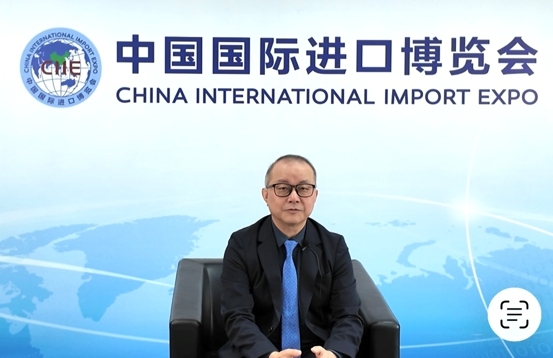
SHANGHAI, Nov. 5 (China Economic Net) – Intel China Chairman Wang Zhichong (Alan Wang) said at the ninth China International Import Expo (CIIE) that Intel’s containerized energy storage and computing solution, dubbed the “Green Computing Pod,” has completed its technical architecture, integrating energy storage, power distribution and computing modules. The company expects the first projects to move toward deployment between the first quarter and the first half of 2027.
Intel entered China in 1985 and has grown alongside the country’s high-tech industry, from the early development of its information technology sector and internet economy to today’s AI boom, Wang said.
The company now has product development engineers in Shanghai, a research institute in Beijing, and a semiconductor packaging and testing facility in Chengdu. It also works with more than 15,000 customers across China.
“We have manufacturing, R&D, technical teams serving China’s local technology industry, as well as business operations. Together, these form a very comprehensive presence in China,” Wang said.
Asked how China’s cost advantages in renewable energy could translate into lower overall AI computing costs, Wang said the idea for the “Green Computing Pod” first took shape in China more than a year ago. It is designed around two emerging trends: the token economy and the integration of computing power with electricity supply.
Western China has abundant renewable energy resources, including solar, hydropower and wind power. However, these resources are geographically dispersed, power generation can fluctuate with weather conditions, and long-distance transmission can involve energy losses.
The basic idea behind the containerized solution is to deploy computing capacity close to where electricity is generated, using locally available green power to run AI computing systems and generate tokens. The computing capacity can then be connected through computing networks, while partnerships with computing service providers help optimize resource allocation and operations. By bringing computing infrastructure closer to renewable energy sources, the solution aims to reduce the cost of producing AI tokens.
Wang described the “Green Computing Pod” as a modular system that can be expanded like building blocks. It does not require a conventional building and can be deployed on available land. Additional pods can be added and interconnected as computing demand grows.
Each pod houses standardized CPU and GPU computing resources, memory, and storage networking, along with an energy storage module designed to handle the rapid power spikes of AI workloads and provide backup when weather conditions limit renewable energy generation. The configuration can be customized to meet specific customer requirements.
The system can be deployed in western China as a large-scale “token factory,” or in a smaller configuration alongside corporate campuses and office buildings, where it can connect to the local power grid or on-site renewable energy sources.
Wang said it took approximately three quarters to complete the technical architecture, covering everything from energy storage and power distribution to computing modules.
“Taking a relatively basic idea and working with upstream and downstream partners, along with dozens of industry partners, to turn it into a deliverable architecture in such a short time —This reflects the efficient collaboration between the Intel team and its partners,” he said.
Wang added that the company expects the first Green Computing Pod projects to move toward deployment between the first quarter and the first half of 2027.
(Editor: fubo )