


XIAMEN, Nov. 6, (China Economic Net)- As the BBNJ Agreement enters its first year in force, the 21st World Ocean Week opened in Xiamen on 5 November, with China's role in shaping and implementing the high seas biodiversity treaty drawing recognition from international participants and setting the tone for a week-long program linking global rule-making, scientific support, and local practice.
Now in its 21st year, Xiamen World Ocean Week has drawn officials and experts from more than 130 countries and regions and over 50 major international organizations, with cumulative participation exceeding 2 million.
Running November 5–11 under the theme "Safeguard the Deep Blue Together, Foster Human-Ocean Harmony," the event brings together representatives from the International Union for Conservation of Nature, the UN Food and Agriculture Organization, the World Economic Forum, the East Asian Seas region's local government network (PNLG), and the PEMSEA Network of Learning Centers, alongside Chinese marine research bodies. The Ministry of Commerce and the China International Development Cooperation Agency are holding three foreign aid training workshops on the sidelines.
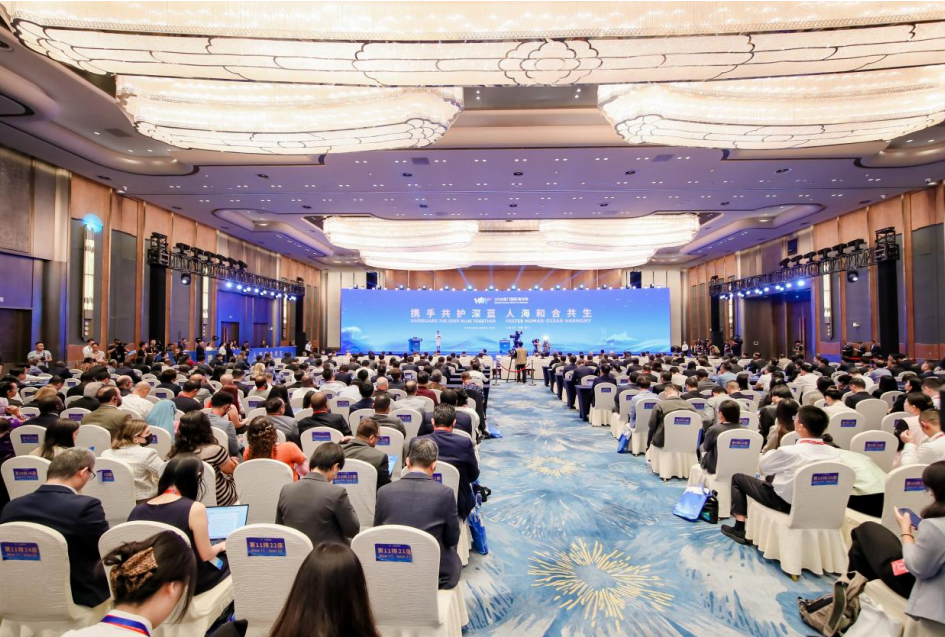
The opening ceremony of the 2026 World Ocean Week, photo provided to CEN
The week's 33 events— one opening ceremony, nine ocean culture exchanges, 19 science and ecology sessions, and four ocean economy matchmaking events, are structured to move from rules to implementation. Sessions on BBNJ science and governance, capacity building training, ocean governance challenges, sustainable development, and international cooperation will draw on multilateral mechanisms including China–ASEAN, BRICS and APEC to advance knowledge sharing, policy dialogue and project matchmaking.
The timing is significant. The Agreement under the UN Convention on the Law of the Sea on the Conservation and Sustainable Use of Marine Biological Diversity of Areas Beyond National Jurisdiction—known as the BBNJ Agreement—entered into force on January 17, 2026, creating the first binding framework for protecting marine life in waters beyond national jurisdiction, which cover roughly two-thirds of the ocean.
During the week, the China Institute for Marine Affairs under the Ministry of Natural Resources released a report assessing the Agreement's status, functions, and prospects, and examining China's role in its conclusion and implementation. The report notes that China contributed expertise and proposals to the design and refinement of the treaty's legal arrangements, helping bridge differences between developed and developing countries.
On marine genetic resources, China advocated upholding the common heritage of mankind principle and creating a benefit-sharing mechanism covering both monetary and non-monetary benefits, safeguarding developing countries' legitimate rights; On area-based management tools, Beijing supported an integrated approach to conservation and sustainable use, respect for state sovereignty and jurisdiction, and stronger coordination with relevant international bodies; on environmental impact assessments, China promoted procedural transparency and the green and low-carbon transition of marine activities; on capacity-building and technology transfer, it backed a country-driven, needs-based approach and diversified cooperation through the Clearing-House Mechanism.
Those positions, the report argues, address both equity and development needs and contribute to global marine biodiversity conservation.
As one of the first signatories and Parties, China has taken practical steps toward implementation. Through expeditions using the Jiaolong and Fendouzhe submersibles and the Shenhai Yihao research vessel, China has opened its research platforms to international partners and shared scientific results. It has pursued voluntary high-seas fishing moratoriums, participated in green shipping corridor initiatives, promoted the Kunming–Montreal Global Biodiversity Framework, and established the Kunming Biodiversity Fund. China has signed marine cooperation agreements with more than 50 countries and international organizations, jointly established over 40 marine research centers and laboratories, and implemented numerous small-scale, high-impact conservation projects strengthening the Global South's ocean-related capabilities.
Beijing has offered to host the BBNJ Secretariat in Xiamen—a bid that, if successful, would place the first UN ocean-related treaty body headquarters in Asia. The first Conference of the Parties will meet January 11–22, 2027, in New York to decide the Secretariat's location and operational arrangements.
The proposal has drawn support from international figures attending the week's events. José María Figueres, former president of Costa Rica, said the Agreement's success "must be measured by results: healthier ecosystems, recovering biodiversity, and stronger international cooperation." He added: "This is where Xiamen has a remarkable opportunity. China has proposed this city as the future home of the BBNJ Secretariat.I warmly welcome and support Xiamen's candidacy. I hope Xiamen will become more than the headquarters of an international institution: a global center for ocean science, diplomacy, and practical conservation solutions, a place where nations share knowledge, strengthen developing-country capacities, and build cooperation across political differences."
Vaipo Mataora, permanent secretary of the Ministry of Infrastructure Cook Islands, voiced a similar view from the perspective of small island states. "Small island countries have vast ocean territories but small populations and limited technical capacity," he said. "We need shared science, shared data, shared skills. Xiamen World Ocean Week brings together governments, scientists, international organizations, and practitioners from around the world. We come to Xiamen willing to learn, willing to share experience, and willing to build lasting partnerships to safeguard a healthy, resilient ocean."
(Editor: liaoyifan )