


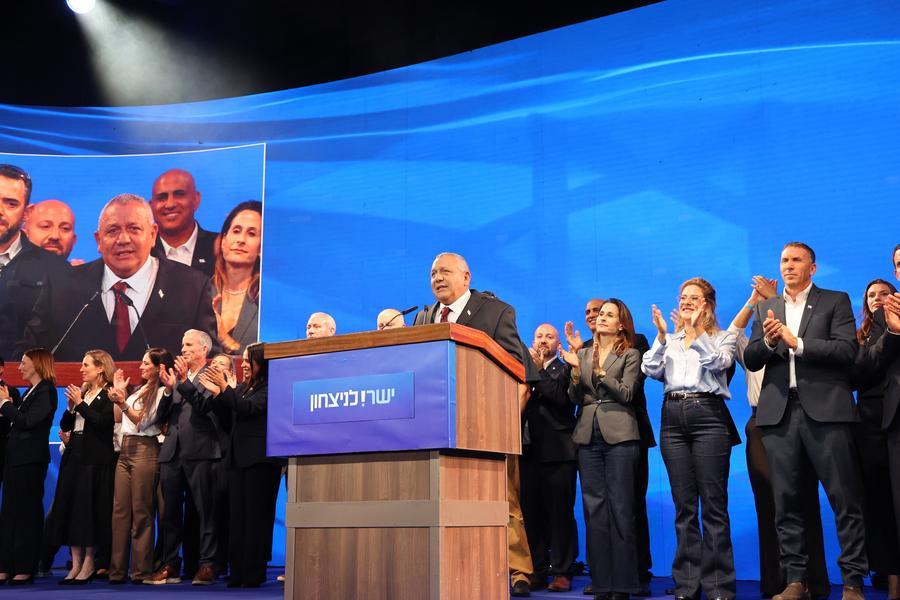
Gadi Eisenkot (C), former Israeli military chief and leader of the centrist Yashar party, delivers a speech at the centrist Yashar party campaign headquarters in Tel Aviv, Israel, Oct. 28, 2026. (Photo by Gil Cohen Magen/Xinhua)
JERUSALEM, Nov. 8 (Xinhua) -- Former Israeli military chief Gadi Eisenkot received a presidential mandate on Sunday to form a government, giving him the first opportunity to unseat Prime Minister Benjamin Netanyahu, Israel's longest-serving prime minister, after an October election stripped his right-wing coalition of a parliamentary majority.
But while Eisenkot has the backing of most lawmakers, deep divisions among Netanyahu's opponents leave him without a clear path to form a government.
WHAT DOES THE PRESIDENTIAL MANDATE MEAN?
On Sunday afternoon, President Isaac Herzog formally tasked Eisenkot, leader of the centrist Yashar party, with forming a government at a ceremony in Jerusalem.
The decision follows consultations with parliamentary factions, during which 67 lawmakers recommended Eisenkot, compared with 46 who backed Netanyahu. Seven others declined to recommend either.
Under Israeli law, Eisenkot will have 28 days to form a government, with a possible 14-day extension granted by the president.
If he fails, Herzog could give another lawmaker, potentially Netanyahu, the opportunity to try. Such a scenario is not unprecedented. In 2021, Netanyahu failed to form a government and the mandate passed to Yair Lapid, who succeeded in forming a coalition. In 2019, both Netanyahu and his rival Benny Gantz failed to form a government, sending Israel to another election.
Netanyahu will remain caretaker prime minister until a new government is sworn in.
CAN EISENKOT FORM A GOVERNMENT?
Israel's electoral system rarely gives a single party enough seats to govern alone, making coalition negotiations routine.
The 2026 election follows years of political turmoil, the devastating war in Gaza and mass protests against Netanyahu over his government's failure to prevent the Hamas-led attack on Oct. 7, 2023, and the handling of the wars that followed.
Eisenkot, a former army chief who entered politics in 2022, has emerged as a challenger appealing particularly to secular and liberal Israelis.
The Oct. 27 election gave Netanyahu's right-wing and religious bloc 53 seats in the 120-member parliament, down from 68, while opposition parties won 67. Yet Eisenkot's four-party alliance holds only 48 seats. The remaining 19 belong to two predominantly Arab parties.
Eisenkot could form a minority government if it wins a parliamentary vote of confidence, which requires more votes in favour than against, rather than an absolute majority of 61 lawmakers.
Eisenkot said he wants to swear in a national emergency government "as quickly as possible," initially comprising his alliance of right-wing, centrist and left-wing parties, with others joining later if they accept its principles.
In a statement on Friday on the social media platform X, he warned against Netanyahu's "dangerous entrenchment" in office and called for "stable and responsible leadership" to prevent another election.
Analysts say such a minority government plan would depend on support or abstentions from Arab lawmakers to survive a parliamentary confidence vote.
However, disagreements have emerged within Eisenkot's alliance over whether to seek support from Arab lawmakers in this vote of confidence.
Avigdor Lieberman, leader of the secular nationalist Yisrael Beytenu party, is pushing for a coalition of at least 61 lawmakers that would include ultra-Orthodox parties but exclude Arab parties.
He has urged a compromise over military conscription to bring the ultra-Orthodox into government, despite Eisenkot's election pledge to end longstanding exemptions from military service for ultra-Orthodox men.
Meanwhile, the Arab-led party Ra'am is seeking a more direct role in the next government.
Its leader, Mansour Abbas, told Israeli daily Haaretz that his party was holding talks with Eisenkot's bloc, including Eisenkot, about possible cooperation.
A senior Ra'am official told the newspaper the party's eight lawmakers would support an Eisenkot government in a confidence vote even without a coalition agreement.
The 11-seat Joint List has also offered to help remove Netanyahu, though neither Arab-led party has entered formal coalition negotiations with Eisenkot. Both have pledged to support replacing the parliament's speaker Amir Ohana, a Likud member.
Eisenkot and several allies have previously ruled out including Arab parties in their coalition, while Lieberman opposes a government dependent on their parliamentary support.
Netanyahu, meanwhile, has intensified his attacks on the prospect of Arab involvement.
In a video statement on Saturday, he accused Eisenkot of planning to govern with "terror supporters," warning that such a government would be too weak to confront threats from Gaza, Lebanon and Iran.
"Israel simply will not survive with such a government," he said.
He instead called for a national unity government including all "Zionist parties," shifting from his campaign demand for a broad right-wing coalition.
Eisenkot has repeatedly ruled out serving under Netanyahu, although his party has left open the possibility of Likud joining a government under his leadership if it abandons its far-right allies.
The mandate gives Eisenkot a chance to end Netanyahu's rule, but his success depends on overcoming divisions over the very parties whose votes could bring him to power.
(Editor: wangsu )