


BEIJING, Nov. 19 (China Economic Net) -- Rows of strawberry plants stood neatly arranged on black plastic mulch inside a greenhouse at Yanjiagang Farm in Harbin, a city in northeast China. Temperature, humidity and light were carefully controlled. Nearby, a display chart traced rice production through ten stages, from seed selection to harvest, with each stage linked to specific techniques and equipment.
For Shehar Shehar Bano, a Pakistani doctoral student in Western Economics at Heilongjiang University, the scene offered a new perspective on agriculture.
Before the visit, she had largely associated farming in Pakistan with small plots cultivated by families, often relying on experience and weather conditions. The greenhouse showed her how precisely agricultural production could be managed.
"I had never realized that farming could be managed in such detail, with every stage of crop growth planned and monitored," she said.
Shehar Bano was taking part in the "Study in Heilongjiang" autumn social practice programme. She visited the Forest Museum at Northeast Forestry University and Yanjiagang Farm, followed by a visit to Maoershan Teaching Area the next day. The experience prompted her to consider how natural resources, agricultural production and local communities are connected.
Beyond natural resources
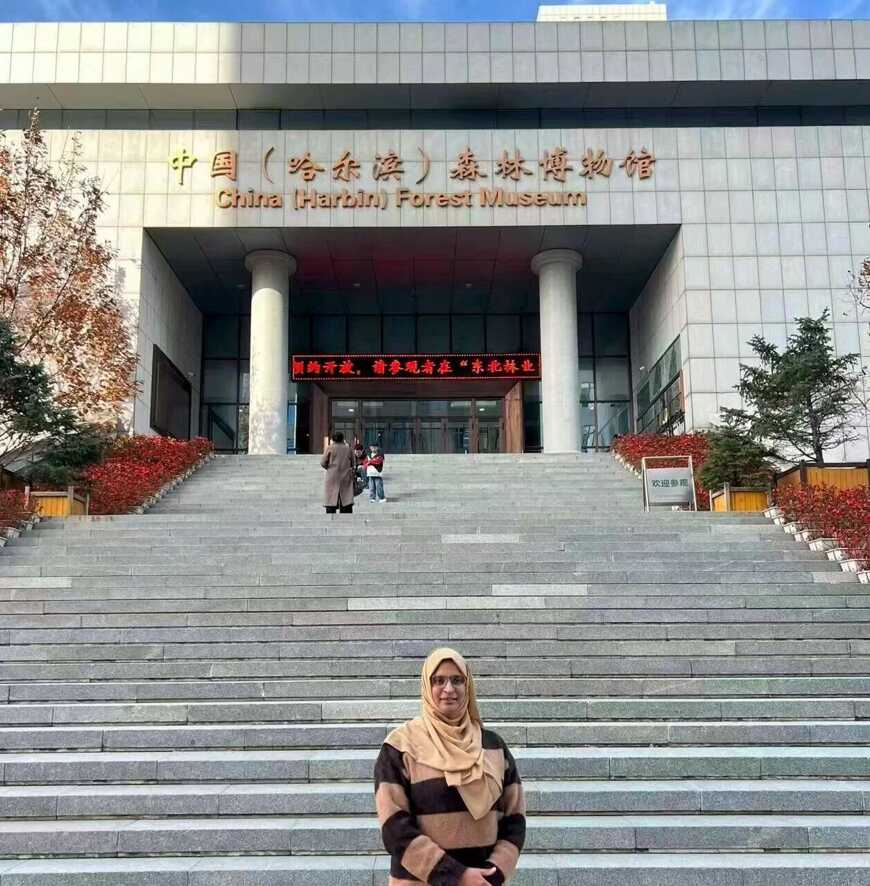
At the Forest Museum, Shehar Bano saw how forests contribute not only timber but also water and soil conservation, climate regulation and biodiversity protection.
The exhibits led her to reflect on Pakistan's environmental challenges. Despite its diverse natural landscapes, including the northern mountains and the Indus River basin, Pakistan has relatively limited forest coverage. Climate change, floods and droughts also put pressure on agricultural production and rural livelihoods.
Pakistan has pursued tree-planting and ecological restoration initiatives, including the Billion Tree Tsunami programme. But Shehar Bano believes that conservation needs to go beyond planting trees.
"Forest protection should not stop at planting trees. Local communities should also be able to benefit from it," she said.
She sees potential in linking forest conservation with local employment through ecological tourism, forest-based products and community services. Such activities, she believes, could create additional income opportunities while encouraging residents to protect the natural resources on which their livelihoods depend.
What a greenhouse revealed about farming
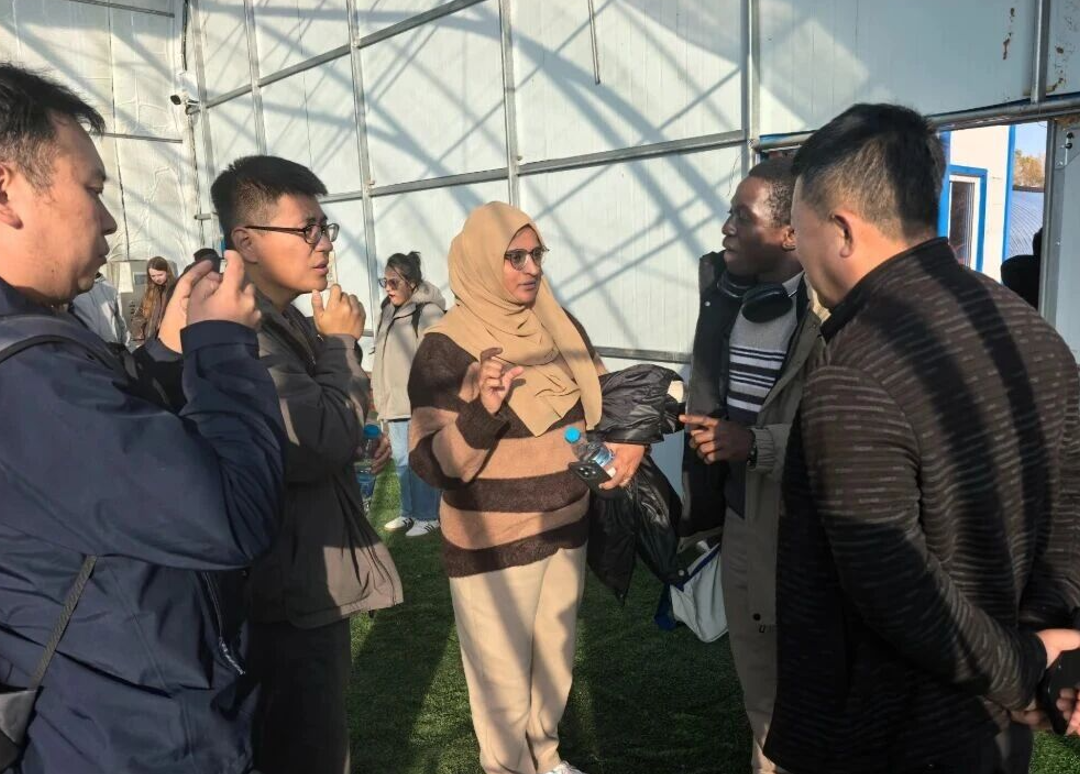
At Yanjiagang Farm, Shehar Bano found a practical example of how technology and management can shape agricultural production.
The visit challenged her earlier assumption that access to land and capital were the main requirements for rural development. The way these resources are organized, she said, can be just as important.
"What often creates the gap in development is not necessarily how much land people have, but their ability to organize and manage it," she said.
For Shehar Bano, modern agriculture involves more than cultivating land. It requires bringing together technology, labour, investment and market connections.
The observation has particular relevance to Pakistan, where agriculture remains a major part of the economy but many small farmers face constraints in accessing quality seeds, irrigation, storage facilities and reliable sales channels.
Her economics studies had introduced her to concepts such as economies of scale and market failures. At Yanjiagang, she began connecting those ideas with practical questions: why can farmers working similar areas of land earn very different incomes? Why do some struggle to cope with price fluctuations after a year of hard work? And how much value is lost when produce cannot be properly stored or transported?
She also saw opportunities beyond crop production. Linking farming with food processing, branding and tourism could give rural communities additional sources of income, rather than leaving farmers dependent solely on selling raw produce.
Connecting conservation with local opportunity
At Maoershan, Shehar Bano found another perspective on rural development. The area's forestry and educational activities prompted her to consider how forest protection could be connected with environmental education and opportunities for local communities.
She drew a comparison with northern Pakistan, including Hunza, Skardu, Swat and Chitral, where natural landscapes and cultural traditions offer potential for ecological tourism and educational travel.
But tourism development, she said, should not be measured only by the number of visitors or hotels built. Local residents need to participate and share in the benefits.
Training young people to work as guides, operate guesthouses and restaurants, or introduce visitors to local culture could help communities gain more from tourism while protecting their environment.
"Good rural development should bring local people into the process, rather than leave them as spectators," she said.
Shehar Bano cautioned against simply copying China's development practices. Differences in land ownership, water resources, climate and social conditions mean that approaches seen in Heilongjiang would need to be adapted to Pakistan.
She sees potential in improving access to quality seeds and water-saving irrigation, strengthening cold-chain facilities, supporting small farmers through contract farming and developing ecological tourism in northern Pakistan. Training and employment opportunities for young people and women, she added, should also be part of the picture.
For Shehar Bano, the visits offered more than a look at different development practices. They raised a question at the heart of her economics studies: how can rural communities make better use of their resources while protecting the environment and improving their livelihoods?
"Perhaps economics is not about making reality increasingly difficult to understand, but about finding ways to make ordinary people's lives better," she said.
As she continues her doctoral studies, she hopes to explore how farming can become more secure and rewarding, how rural communities can retain younger generations, and how natural resources can be protected while creating income for local residents.
(Editor: wangsu )