


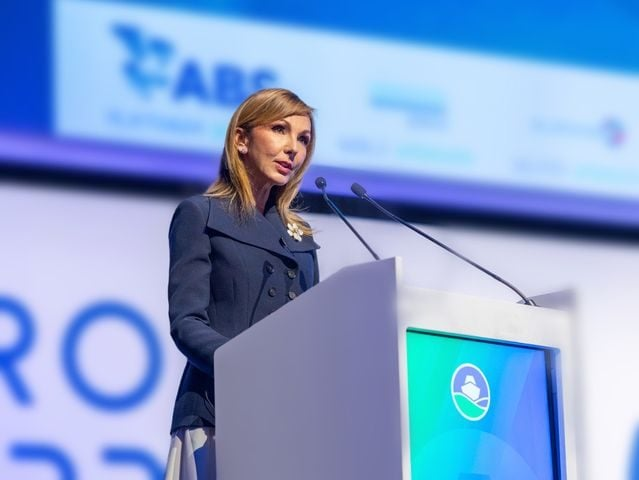
The president of the Union of Greek Shipowners (UGS), Melina Travlos, has criticised the European Union's approach to negotiations on shipping decarbonisation, warning of the risk of a fresh deadlock at the International Maritime Organization (IMO).
Ahead of the resumption of crucial talks in London, scheduled for 23 November to 4 December 2026, Travlos said in a statement that, two months after the last unsuccessful round of discussions, there was still no sign of meaningful progress towards an agreement on reducing greenhouse gas emissions from international shipping.
She noted that Greece, together with three other EU member states, which collectively control 70% of the EU-controlled fleet, had stressed the need for Europe to approach the negotiations with a genuine willingness to find a compromise. Their appeals, however, failed to bring about any change.
Travlos criticises political inconsistency on the part of the EU
The UGS president described the EU’s stance as marked by political inconsistency, arguing that its lack of flexibility is undermining the IMO negotiations before they resume.
She also questioned whether the EU’s real priority is ultimately to preserve its own regional measures and the revenues they generate, rather than secure a balanced global agreement.
Travlos argued that Europe’s approach allows other interests to take precedence over the need to find an internationally acceptable solution for shipping’s energy transition, placing an additional burden on European citizens, who are already facing a rising cost of living.
The cost and availability of green fuels
Travlos placed particular emphasis on the need for environmental targets to reflect actual market conditions and the shipping industry’s level of technological readiness.
In this context, she stressed that account must be taken of the availability and cost of alternative fuels, the scope for their widespread use, the development of the necessary infrastructure, and competing demand for these fuels from other sectors of the economy.
The UGS president also pointed out that shipping’s decarbonisation cannot rely exclusively on alternative fuels. Instead, the new regulatory framework must recognise all effective ways of reducing emissions, including technical and operational measures to improve ships’ energy efficiency.
Call for a global agreement
Travlos underlined that the IMO’s greenhouse gas strategy allows flexibility in how environmental targets are met, and that the mid-term measures currently under negotiation should form part of an evolving regulatory framework rather than serve as the only means of achieving the energy transition.
She also called on the IMO’s member states to consider all viable solutions and demonstrate the political will needed to bridge their differences.
The objective, she stressed, must be to establish a global, balanced and workable framework for achieving meaningful reductions in shipping emissions without undermining international trade, food security and economic growth.
(Editor: wangsu )